
Plastic Pollution Behemoth Begs for Solutions [1]
 [2] |
BookShelf: Plastic Pollution Behemoth Begs for Solutions
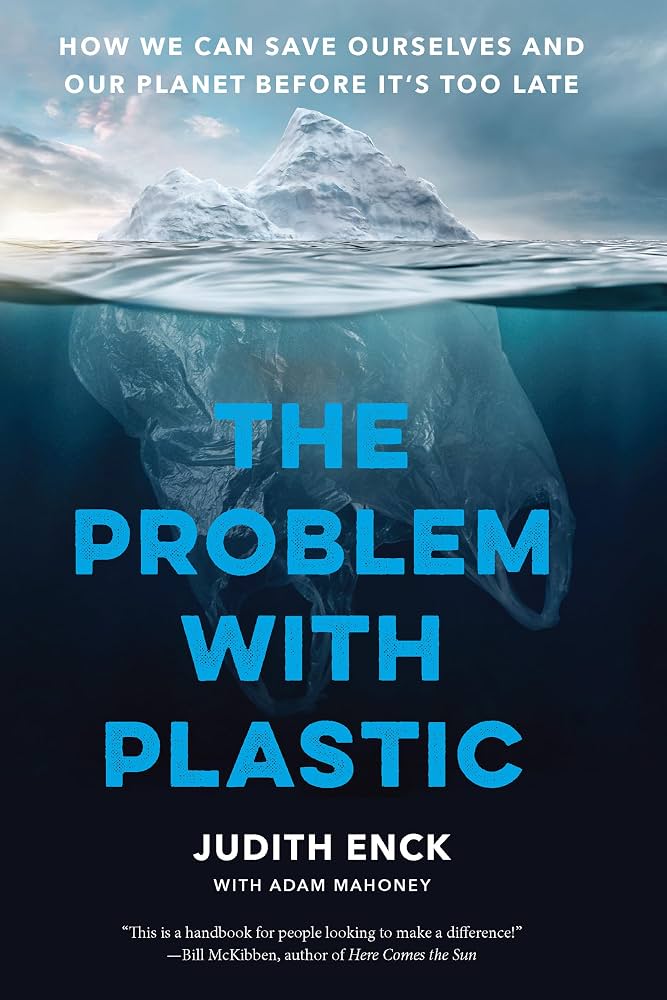
“The Problem With Plastic: How We Can Save Ourselves and Our Planet Before It’s Too Late”
By Judith Enck, with Adam Mahoney
The New Press, $27.99
 |
Reviewed by Tom Henry
Let me start by saying this is an incredibly useful book, especially for environmental journalists.
It’s a concise, easy-to-understand, fascinating read about one of Earth’s biggest sources of pollution — one that came on relatively quickly and is poised to get exponentially bigger.
It has a lot of those other elements we all like to see in books, but it also has a bit of a problematic title.
I’m saying that tongue-in-cheek, of course. But if you think about it, there is no single problem with plastic.
As Judith Enck makes clear in “The Problem With Plastic: How We Can Save Ourselves and Our Planet Before It’s Too Late,” there have been countless problems created for our environment and for our public health by society’s addiction to plastic and the petrochemical industry’s willingness to feed it.
We’ve got microplastics, nanoplastics and the class of forever chemicals known as PFAS building up in our rivers, streams and lakes.
They’re getting into fish and wildlife, thereby moving up the food chain, but they’re also so ubiquitous that you can’t avoid them by simply changing your eating habits. They’re in your sweaters and other types of clothes you wear that have polyester fibers. They’re in your automobile’s tires.
They’re in the air you breathe and the bottled water you drink. They’re in virtually every organ of the human body, building up over time and taking humanity down an uncharted path.
And, as if all of that wasn’t bad enough, they’re mostly produced in neighborhoods where they pass along a disproportionate amount of pollution to disadvantaged populations, a classic example of environmental injustice.
Parallel insights from another plastics expert
There were times when I was reading this book that I could hear recent words delivered at a guest lecture I attended at the University of Toledo this fall by Sherri “Sam” Mason of Gannon University in Erie, Pennsylvania.
Mason is not in this book, but she and Enck are two of the best-known plastics researchers.
They appeared together on a panel at the Society of Environmental Journalists’ annual conference [3] in Chicago last April, along with California Attorney General Rob Bonta, who filed a landmark lawsuit against Exxon Mobil in September 2024. In it, Bonta accuses the petrochemical giant of deceiving the public about plastics recycling for decades.
“I’m not the most popular person at parties,” Mason joked during her guest lecture inside the University of Toledo auditorium. She said she generally tries to be an optimistic person, but fears the issue of plastics will get worse as the fossil fuel industry transitions more into that line of business.
Mason also noted during that lecture in Toledo that other threats to the environment and public health, such as cancer-causing polychlorinated biphenyls, industrial lubricants commonly known as PCBs, have been banned and are, thus, on the decline.
Plastics, on the other hand, are growing exponentially.
Hits the mark for lay readers and experts alike
Enck, as many people know, is a former U.S. Environmental Protection Agency regional administrator from the Northeast who founded the Beyond Plastics activist group at Bennington College in Vermont, where she teaches classes on plastic pollution.
First, let it be said that she and others who had a hand in writing this book didn’t give us something that reads like a government document. In her acknowledgments, Enck said the book grew out of a Beyond Plastics team effort and cites seven individuals in particular for their contributions.
The final product is a clear,
well-written book that lays out
the history of plastic pollution
and why it’s become so important.
To everyone’s credit, the final product is a clear, well-written book that lays out the history of plastic pollution and why it’s become so important, especially with the actual rate of recycling being so incredibly pathetic.
It hits the mark as an overview for a lay audience, a book that’s easy enough on the eyes for newcomers to the subject and something that offers intrigue to those more well-versed on the subject.
I don’t mean this as a criticism per se, but I was a little thrown off in the latter pages by what appeared to be an obligatory nod to all of the women fighting for the planet. It’s perfectly fine to highlight them, but the short vignettes didn’t seem to be adding a whole lot and came off as a little distracting. It seemed like fodder for another book, perhaps.
Lofty solutions, but how realistic?
Enck’s vision for the future is a bit different from Mason’s helpless feeling near the end of that University of Toledo guest lecture I mentioned.
In her book, Enck offers several ideas for reversing the damage, although many of them appear like grandiose, collective social movements to mobilize people into demanding change. And, in this cynical world we live in, that’s hard. Look at how hard it’s been mobilizing the world to confront the realities of climate change.
I don’t disagree with Enck’s lofty recommendations; I just wonder how realistic they are. Sure, we’d all benefit from using fewer plastic bags at the grocery store, working together to hold the plastics industry accountable and calling out corporate greenwashing, aka marketing bull, when we see it. I’ve long argued that one of the easiest things people can do is to stop bagging their gallons of plastic milk at the checkout lane.
Oh, well. At least Enck made a convincing argument to me that I wasn’t taking the impact of plastic straws seriously enough. She does make some valid recommendations and, truth be told, I’d be in favor of more bulk bin purchases — though I question if the general public would, post-COVID — and I prefer glass containers over plastic ones, any day. I don’t see as much fruit wrapped in cellophane these days, so maybe there’s hope.
Something’s gotta change, though,
and Enck’s book gives us the why.
Something’s gotta change, though, and Enck’s book gives us the why.
Consider that nearly half of all plastic ever created has only been around since 2007, the year the first iPhone debuted.
“Plastic has quickly become a monument to our disregard for the interconnectedness of life,” Enck writes in her conclusion. “The oceans groan beneath the weight of our collective legacy, a tide of plastic and waste borne of an age that epitomizes a throwaway society.
“The waves carry the ghosts of our overconsumption — single-use plastic bottles, bags, and packaging,” she continues. “Yet this is no natural catastrophe; it is human-made, and that means it can be unmade.”
Let’s hope so.
Tom Henry is SEJournal’s BookShelf editor and a former board member for the Society of Environmental Journalists who created The (Toledo) Blade’s environment beat in 1993. His last review was of “Planet Aqua: Rethinking Our Home in the Universe [4].”
* From the weekly news magazine SEJournal Online, Vol. 11, No. 42. Content from each new issue of SEJournal Online is available to the public via the SEJournal Online main page [5]. Subscribe to the e-newsletter here [6]. And see past issues of the SEJournal archived here [5].