
At COP30, Amazon Rainforest Is Center Stage for Climate Catastrophe [1]
 [2] [2] |
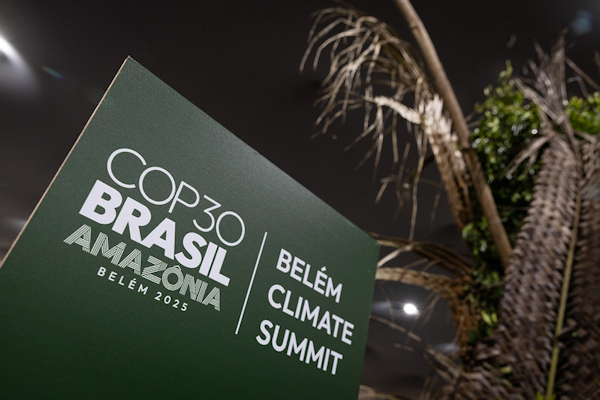 |
| As delegates from around the world arrive at COP30 talks in Brazil, the Amazon rainforest — a crucial piece in the climate change puzzle — faces a disastrous future. Photo [3]: UN Climate Change/Kiara Worth via Flickr Creative Commons (CC BY-NC-SA 4.0 [4]). |
Backgrounder: At COP30, Amazon Rainforest Is Center Stage for Climate Catastrophe
By Joseph A. Davis
The Amazon rainforest will likely get a lot of attention as the COP30 United Nations’ climate change meeting gets underway in Belém, Brazil, this week.
That shouldn’t be surprising. The tropical forest encompasses 1,200,000 square miles and takes in the territories of nine nations, while covering much of the drainage basin — by most measures the world’s largest — of the Amazon River, which itself is the largest river in the world by discharge volume (although some think the Nile is longer).
Brazil contains the largest share of the Amazonian rainforest (60%), followed by Peru (13%) and Colombia (10%), with smaller portions in Venezuela, Ecuador, Bolivia, Guyana, Suriname and French Guiana. And roughly one-third of the Amazon rainforest, the part that is declining less rapidly, is Indigenous territory.
The problem is that the rainforest is disappearing.
For some years, conservationists’ biggest fear
about the Amazon was that it was burning.
But now, one of the wettest places in the world
is also at risk of being destroyed by drought.
For some years, conservationists’ biggest fear about the Amazon was that it was burning. It was — and has been burning even more in recent years.
Virtually none of these fires are natural. They are started by humans, to clear land. The technique is called slash-and-burn. Trees are cut or killed, left to dry out and then set ablaze. It is a very ancient practice hardly limited to the Amazon.
But now, one of the wettest places in the world, long hailed as a spongy “sink” for planet-warming carbon dioxide, is also at risk of being destroyed by drought, and may already be emitting more CO2 than it absorbs [5].
Amazon’s origins and peopling
The Amazon rainforest has been there for a very long time (depending on your perspective). And it’s been wet for a long time.
Roughly 15 million years ago, the Amazon Basin was covered by a huge lake. Over successive ice ages, the Andes Mountains arose and the lake drained via what became the Amazon River.
The latest archaeology suggests that humans have lived in the Americas far longer than was previously believed. A few decades ago, the earliest remains archaeologists knew about were from the Clovis [6] culture, roughly about 13,000 years ago, in North America.
But more evidence has emerged, and dating techniques have advanced with sophisticated DNA analysis. Today, speculative dates for the earliest peopling of South America go back as far as 33,000 years. So humans may well have lived in the Americas before the most recent ice age, and long before the Pyramids were built.
For more perspective: The Neanderthal species only went extinct about 40,000 years ago and the agricultural revolution happened in Eurasia only about 11,000 years ago. Meanwhile, archaeologists have found evidence that squash was cultivated in what is now Peru as long as 10,000 years ago [7] (may require subscription).
So the agricultural revolution happened in the Americas almost as early as in Eurasia. Humans and the Amazon adapted to each other.
The difference today is that there are a lot more people clearing a lot more land.
The Amazon is wet — but getting drier
One of the Amazon rainforest’s most valuable treasures is water. In fact, it is one of the wettest places on Earth.
 |
| The Amazon has experienced decades of drying, but more recently it’s seen three years of unusual and persistent drought. Photo [8]: Hudsӧn via Flickr Creative Commons (CC BY-NC 2.0 [9]). |
On average, annual rainfall amounts to about 60 to 120 inches [10] a year, varying by season and place. Yes, five to 10 feet! The river system itself discharges roughly 15-16% of the Earth’s total river discharge into the oceans.
The Amazon forest actually creates about half of its own rain. Its 390 billion trees suck moisture up from the ground and breathe (“transpire”) it out through pores in their leaves — creating a massive cloud system from which rain falls back onto the forest.
The rest of the moisture goes elsewhere, making the rainforest a watering can for other parts of the globe.
But in recent years, the Amazon has experienced unusual and persistent drought [11]. Three years [12] of it, most recently — and decades of drying, if you go back.
The Pantanal [13], the world’s largest tropical wetland, was severely dry last year. Low flow on the Amazon and its tributaries also halted a lot of navigation.
The drought was exacerbated by climate heating [14], deforestation and the ENSO (El Niño-Southern Oscillation) [15] cycle, among other things. Some 17% of the Pantanal burned last year. One result: more fires.
It’s a downward spiral.
Deforestation still running wild
During much of the time since Europeans arrived in the Americas, the Amazon forest was inaccessible. But people started carving out more ranches by the 1960s. By the 1970s, the building of roads into the interior, such as the Trans-Amazonian Highway, increased access and deforestation.
Now, the economic and political pressures tending to degrade the Amazon are huge and persistent. Deforestation has accelerated in recent decades, although it has varied considerably from year to year. Lots of other extractive activities have also degraded the rainforest: rubber, mining (especially gold) and palm oil, for example.
Amazon deforestation has been an ongoing
nightmare scenario. Some 26% of the forest
was considered deforested or highly degraded
in 2022 — more than 17% lost entirely.
Amazon deforestation has been an ongoing nightmare scenario. Some 26% of the forest was considered deforested or highly degraded in 2022 — more than 17% lost entirely [16].
Most of the land that is deforested goes to cattle ranching (about 80%). Brazil turns out to be the largest exporter of beef in the world. The biggest share of that beef goes to China, with the second biggest share going to the United States (although that may be upset under the unpredictable tariff policies of Trump 2.0). Another 15% of the deforested land goes to soybean farming.
Although Brazil’s President Luiz Inácio Lula da Silva has adopted policies meant to preserve the Amazon more actively than his extraction-happy predecessor Jair Bolsonaro, the rainforest is still taking hits.
Will climate change dry up the Amazon?
Water flow in the Amazon and its tributaries has gotten lower [17] in the last several years [18]. The impact has been enormous: loss of navigability, mortality among threatened Amazon River dolphins [19] and displacement [20] of human populations, for example.
The question is why.
The answer is cloudy but important. It would be easy to lay some of the blame [21] on the ENSO climate cycle. Deforestation [17] itself may be adding to the drought. And a more recent uptick in Amazon rains — while encouraging — may simply reflect seasonal and ENSO changes. The Amazon Basin has its own wet-dry cycles, and these are not well understood.
So, as the COP30 U.N. climate talks [22] begin literally in the heart of the Amazon basin, it is a good time to consider the obvious question.
For decades, the political mandate to “Save the Rainforest” was based on the understanding that — by absorbing carbon dioxide — the Amazon was a solution to the alarming increase in climate heating.
But the clouds that do or don’t hang over COP30 delegates in Belém may signify something darker.
Climate change may be helping destroy the Amazon rainforest, which some fear could be rapidly nearing a tipping point [23] where it would largely vanish and become savanna, robbing the planet of a major defense against accelerating climate change.
[Editor’s Note: Read our recent COP30-related columns, “Tapping Into COP30 To Cover Indigenous Issues [24]” from our Voices of Environmental Justice section, and our Issue Backgrounder, “COP30 — Why It Won’t Save the Planet [25].” Plus, see COP30-related headlines [26] from EJToday. For more on covering climate change, visit our Topic on the Beat [27] page, with a library of related SEJournal stories; our Climate Change Resource Guide [28]; and special reports on Covering Climate Solutions [29], Covering Your Climate: The South [30] and Covering Your Climate: The Emerald Corridor [31].]
Joseph A. Davis [32] is a freelance writer/editor in Washington, D.C. who has been writing about the environment since 1976. He writes SEJournal Online's TipSheet [33], Reporter's Toolbox [34] and Issue Backgrounder [2], and curates SEJ's weekday news headlines service EJToday [35] and @EJTodayNews [36]. Davis also directs SEJ's Freedom of Information Project and writes the WatchDog [37] opinion column.
* From the weekly news magazine SEJournal Online, Vol. 10, No. 40. Content from each new issue of SEJournal Online is available to the public via the SEJournal Online main page [38]. Subscribe to the e-newsletter here [39]. And see past issues of the SEJournal archived here [38].