"Forecasters: New, Lesser Storm May Hit East Coast"
"WASHINGTON -- Another messy — and wintry — storm may cause post-Election Day problems for an already weather-weary East Coast, forecasters say."
Source: AP, 11/02/2012




"WASHINGTON -- Another messy — and wintry — storm may cause post-Election Day problems for an already weather-weary East Coast, forecasters say."
"In a surprise announcement, Mayor Michael R. Bloomberg said Thursday that Hurricane Sandy had reshaped his thinking about the presidential campaign and that as a result, he was endorsing President Obama."
"Nearly 4.5 million homes and businesses in 12 U.S. states remained without power on Thursday afternoon, three days after Hurricane Sandy battered the U.S. East Coast, federal data showed."

Interviewing survivors: a Canadian Association of Journalists/Ryerson University panel discussion on best practices and ethical considerations of journalism and remembrance at Ryerson in Toronto, Ontario, Canada from 6:30-9 p.m. (doors open at 6 p.m.)

This free National Academies Institute of Medicine workshop in Washington DC will bring together members of the ecology, ecosystem services, and health communities to gain a better understanding of the connections between coastal waterways and ocean processes and public health risks and benefits. A live webcast of the workshop will also be available for those who are unable to attend in person.
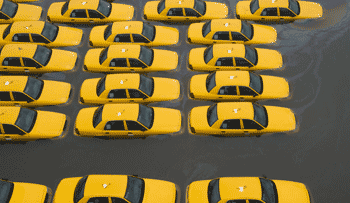
(Photo: AP)
Floodwaters have not yet receded from many parts of the Northeast after Sandy's inundation. Those waters are often quite polluted, and people's health will depend on public understanding of the threat. Here are some resources for journalists to use in covering it.
"Federal regulators have announced the results of a September inspection blitz targeting 13 coal mines in seven states 'previously cited for violations regarding respirable dust sampling ... inadequate dust control ... and hazard complaints' involving excessive coal dust."
"For a superstorm, hurricane Sandy has had surprisingly little effect on gasoline prices."
"Even in areas hit hard by the storm, gas prices were up only nominally on the first day: less than a penny in Baltimore, Philadelphia, New York, and Boston, according to GasBuddy.com, a group of local websites that track gasoline prices. By the second day, they had stabilized or were falling again.
If anything, hurricane Sandy may be helping to push prices down faster.
"'Ocean grabbing' or aggressive industrial fishing by foreign fleets is a threat to food security in developing nations where governments should do more to promote local, small-scale fisheries, a study by a U.N. expert said on Tuesday."
"As Hurricane Sandy pushed floodwater through New York's streets and into its subways, many wondered how the city's infamous rat population would fare -- sink or swim?"