



SEJournal Online is the digital news magazine of the Society of Environmental Journalists. Learn more about SEJournal Online, including submission, subscription and advertising information.
February 25, 2026
 |
BookShelf: Is Our Inextricable Link to Water the Key to Human Survival?
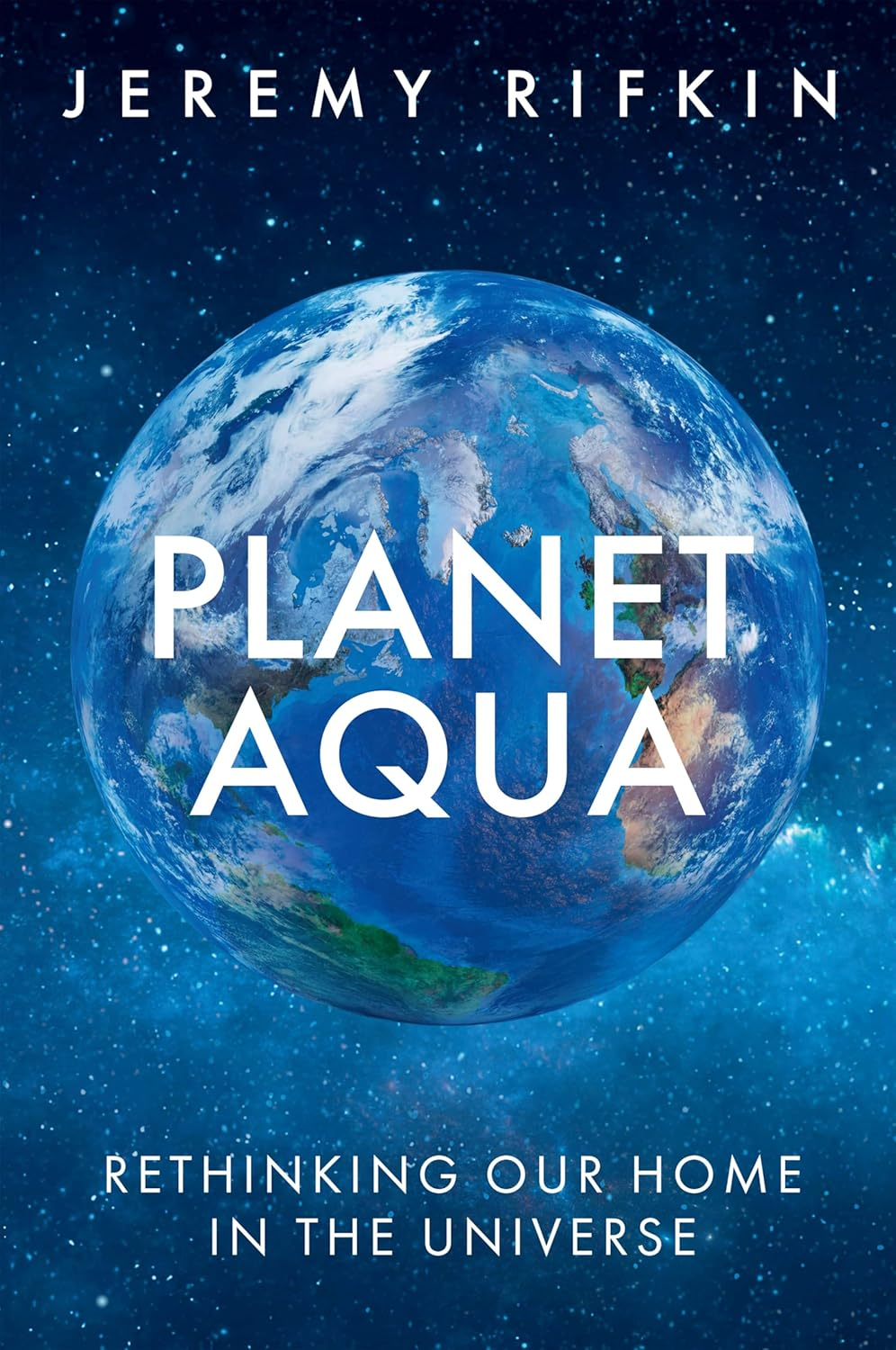
“Planet Aqua: Rethinking Our Home in the Universe”
By Jeremy Rifkin
Polity Books, $29.95
Reviewed by Tom Henry
 |
Jeremy Rifkin, a bestselling author of 23 books who has been listed among the Top 10 most influential economic thinkers by the Huffington Post, presents a fascinating premise in “Planet Aqua: Rethinking Our Home in the Universe.”
And that is, simply, that human beings should stop thinking about Earth as a “land planet” and come to realize it is a “water planet.”
By that, Rifkin doesn’t just mean that the Blue Marble, as he occasionally calls Earth, has a combined footprint of oceans that is much greater than that of the continents, either.
No, he does a deep dive into anthropology to explain how the Earth was formed and how mankind has been inextricably linked to water.
He shows what a mistake it has been for man to think he had dominion over it, every bit as foolhardy as it has been for man to think he had dominion over nature itself.
He explains why modern trends such as the slow-water movement are not only good for the planet but essential for its survival.
He writes about water conflicts, though perhaps glossing over the Great Lakes region a little more than I would have liked.
But his information about the Tigris-Euphrates river system in West Asia that flows into the Persian Gulf is outstanding, and I found his chapter about the Mediterranean to be one of the more fascinating in this book, which is chock-full of highlights and incisive research.
One great hydrosphere
Perhaps the biggest point that Rifkin makes throughout this highly ambitious, sweeping book is that we’re not a collection of bodies of land, and we’re not a collection of bodies of water.
Nor should we just dwell on past mistakes, such as the monumental draining of the Aral Sea, which ranks among the worst things mankind has ever done to the planet.
Instead, we need to realize that we are all part of one great hydrosphere, the word used to describe all water that is on Earth’s surface, beneath it and in the air.
Rifkin, who has served in official advisory roles to the European Union, China and the United States on climate change issues, believes that mankind’s future depends heavily on the relationship between climate change and the hydrosphere.
‘The hydrosphere is now dictating
the terms regarding the future
evolution of the planet.’
— Jeremy Rifkin
“It’s no longer our choice to make,” he wrote. “The hydrosphere is now dictating the terms regarding the future evolution of the planet — the intensification of the snows, floods, droughts, heatwaves, firestorms, and hurricanes is already forcing our hand. Hundreds of millions and likely several billion of our human family will be forced to migrate to safer havens where they can find livable habitats and adapt to the waters.”
Humans have naively “lived with the mass delusion that the whole of the waters on the Blue Planet could be tamed and domesticated,” Rifkin wrote.
He provides a long history of public works projects — especially out West, but also in other areas around the world — that have exposed human arrogance and underestimations about the power of water.
Those include, of course, anything from rechanneling rivers to megadams. He also provides some newer information on desalination and the rapid advancements in making potable water out of human wastewater.
Water as a life-sustaining force
Rifkin makes a strong case for why water needs to be respected as a life-sustaining source and not a product to produce energy and other industrial uses. It should not continue to be viewed as a resource to be exploited and manipulated.
He claims Earth, in some ways, is rebelling against us now for those centuries of water-based abuse, and that the symptoms are showing themselves through the effects of climate change.
“This sad state of human affairs is occurring even as the realization sets in, at least among the young, that a warming climate brought on by climate change is taking the whole of the human population and our fellow creatures to a mass graveyard,” Rifkin wrote.
Along the way, he looks at anything from how gender stereotypes have played into perceptions of water to how the Roman Empire’s hydraulic system led to its collapse.
Rifkin believes that nomadism is “baked into our physiology” and “has been critical to our flourishing and survival through history.”
That’s important, he adds, because “we are facing the greatest mass migration in human history in the throes of a global warming climate and the sixth extinction of life on the planet.”
By 2050, he projects 4.7 billion people — roughly half of the world’s population — will live in countries with “high and extreme ecological threats.”
Climate migration has already begun in several parts of the world, especially from the Middle East and North Africa. Rifkin argues that the whole notion of sovereign governance and geopolitics as we know it today could be much different in the future as more people take to the road in search of more livable climates.
He finds it incredible that the existing United Nations covenants and protocols do not recognize climate refugees, despite migration that has already begun. The U.N. covenants only provide protection against human abuses.
Don’t go into this book thinking it’s a clever way of repackaging familiar statistics and talking points about water, especially vanishing supplies of fresh water, because it’s not.
It’s a book for those who want
both a look back at how we got
to where we are but also a
vision for the future.
It’s a book for deep thinkers, for those who want both a look back at how we got to where we are but also a vision for the future.
There isn’t flowery, feel-good rhetoric to assure readers that everything is going to be fine.
This is an intense, wide-reaching narrative that strives to upend conventional wisdom about our planet and our relationship with water.
Tom Henry is SEJournal’s BookShelf editor and a former board member for the Society of Environmental Journalists who created The (Toledo) Blade’s environment beat in 1993. His last review was of “Welcome to Florida: True Tales from America’s Most Interesting State.”
* From the weekly news magazine SEJournal Online, Vol. 11, No. 8. Content from each new issue of SEJournal Online is available to the public via the SEJournal Online main page. Subscribe to the e-newsletter here. And see past issues of the SEJournal archived here.
SEJ Publication Types:
Topics on the Beat:
Visibility: