


Journalists are eligible for free email subscriptions to SEJournal, including TipSheet, WatchDog (on access issues) and more.
Here's a sampling of past SEJ regional events. To co-sponsor a regional event like this in your area, contact SEJ: sej@sej.org or (202) 558-2055. To organize or attend an SEJ-member-led meet-up, visit this page. Check out upcoming regional events here.
DC SEJ Happy Hour
June 2, 2024
SEJ DC-area members who met at this year's SEJ conference in Philadelphia gathered June 2 at the Midlands Beer Garden in Petworth/Columbia Heights. The event was organized by Becca Milfeld, r.milfeld@gmail.com, and Shannon Kelleher, shannon.kelleher@ewg.org.
Roundtable: 2024 Journalists’ Guide to Energy & Environment
November 16, 2023
 Watch the video recording of the 12th annual edition of the Journalists’ Guide to Environment + Energy on November 16 in Washington, DC, where leading environmental journalists from major news outlets predicted the top stories of the year ahead, David Byrne joined as our special guest and the winner of the $10,000 Nina Mason Pulliam Award for Environmental Reporting was announced and presented live. Event details, recording and chat log.
- "2024 Journalists' Guide to Energy and Environment" (SEJournal's special report looking ahead to key issues in the coming year)
Virtual: 2023 Journalists’ Guide to Energy & Environment
February 9, 2023
 On Feb 9, SEJ held a virtual webinar looking at the year ahead in the just-released "Journalists' Guide to Energy & Environment," moderated by #SEJ2023 co-chair Tom Michael. Top stories for energy and environmental journalists to cover in 2023: environmental justice, climate change and biodiversity, clean energy and the critical minerals rush, wildfire and public lands management, indoor air quality and salmon and dams. We'll be touring and discussing all these issues and more at SEJ's 32nd annual conference in Boise, Idaho, April 19-23. On Feb 9, we also previewed #SEJ2023 agenda and issues. Event details, recording and chat log.
- "2023 Journalists' Guide to Energy and Environment" (SEJournal's special report looking ahead to key issues in the coming year)
Virtual: 2022 Journalists’ Guide to Energy & Environment
February 9, 2022
 The Society of Environmental Journalists' 10th annual look ahead at the year's key energy and environmental issues took place Feb 9, moderated by #SEJ2022 co-chair and ProPublica/Texas Tribune Investigative Unit's Perla Trevizo. Event details, recording and chat log.
- "2022 Journalists' Guide to Energy and Environment" (SEJournal's special report looking ahead to key issues in the coming year)
Virtual: 2021 Journalists’ Guide to Energy & Environment
January 27, 2021
 Watch the recording of the Society of Environmental Journalists' 9th annual look ahead at the year's key energy and environmental issues. Hosted virtually by National Geographic Society and co-sponsored by the Wilson Center, the event kicked off with a prerecorded interview with new White House National Climate Advisor Gina McCarthy, followed by a live interview with Senator Sheldon Whitehouse, D-RI, and SEJ's annual panel of leading journalists offering their predictions for the year ahead. Event details.
- "2021 Journalists’ Guide to Energy & Environment" (SEJournal's special report looking ahead to key issues in the coming year)
Roundtable: 2020 Journalists' Guide to Energy & Environment
January 24, 2020
 An overflow crowd of environmental reporters and others gathered in Washington, D.C., on January 24 at the Society of Environmental Journalists’ annual look-ahead on environment and energy news to hear what speakers like the former United Nations head and top journalists see as the news to watch for. Find out what one story dominated. Plus, watch video of the full program.
Straddling the Climate and Policy Divide: A Colorado Journalists' Roundtable
 May 3, 2019
At Colorado State University's Denver Center, SEJ hosted a robust journalists' panel and public discussion on Colorado's challenges and opportunities regarding droughts, wildfires, climate change, energy production, decarbonization and more. The event included an interview with Will Toor, executive director of the Colorado Energy Office Details.
Telling the World's Stories: Reporting on Biodiversity and Community-Based Conservation
 April 11, 2019
To increase and improve coverage of biodiversity, SEJ's Fund for Environmental Journalism offered grants of up to $5,000 for stories on these issues (Spring 2019 round; May 15 deadline). To help applicants prepare the best FEJ proposal, SEJ hosted an interactive webinar with leading experts on biodiversity and journalists who cover it. They provided an introduction to the top issues, shared new data sources, and offered advice and story tips. A Q&A with webinar participants was moderated by SEJ board member Gloria Dickie (pictured).
Roundtable: 2019 Journalists' Guide to Energy & Environment
January 25, 2019
 On January 25 in Washington DC, SEJ and the Wilson Center presented the 7th annual Journalists' Guide to Energy and the Environment, where top reporters looked ahead at 2019's biggest stories to a packed house.
Separating Facts from Fake News: Environmental FOIA in the Trump Era
November 3, 2018
For those who use FOIA requests in their work but wish they were better at it, SEJ co-sponsored this free workshop at the CUNY Law School in New York with some of the nation’s top lawyers and journalists who use FOIA in their environmental reporting and litigation. The event was livestreamed in part to some colleges around the country. Event details.
2018 Journalists' Guide to Energy & Environment
January 26, 2018
 From pipeline politics to hurricane horrors, 2017 witnessed a flood of energy and environment news — and 2018 promises to set a new high-water mark. On Friday, January 26 at the Wilson Center in Washington, DC, the Society of Environmental Journalists (SEJ) launched its annual report, "The Journalists' Guide to Energy and Environment,” which previewed the top stories of 2018, with comments from a roundtable of leading journalists. If you were unable to attend in person or watch it online, the webcast is archived here. See details of the event.
Trump and the Cascades: How Federal Environmental Policies May Impact the Northwest
July 6, 2017
 SEJ hosted a public forum for journalists examining Trump environmental policies at the Seattle Aquarium on July 6, 2017. The evening comprised two moderated panels. The policy panel examined the impact of, and response to, specific federal actions whether they have already occurred or may occur in the future. The journalists’ panel sought to identify stories and examine the reporter’s role in covering them.
- SEJ News: "‘Cut Through Fog’ to Cover Trump’s Fast-Moving Environmental Policy Changes," July 18, 2017.
- "Trump 'review' will keep hands off Hanford Reach National Monument," Seattle Post-Intelligencer, July 12, 2017 by Joel Connelly.
- Dennis McLerran's remarks.
- See some photos of the event on Facebook.
SEJ Has Strong Presence at This Year's IRE Conference
June 22-25, 2017
 This year’s Investigative Reporters and Editors conference in Phoenix, June 22-25, featured a sizable contingent of SEJ members, including three panels with environmental themes and another successful SEJ meet-up to introduce our organization to journalists who don’t yet know about us. Read more and see photos here.
Searching for Truth in the Age of Alternative Facts
April 20-23, 2017
 The Society of Environmental Journalists invited SEJ member journalists to apply for a multi-day reporting workshop, "Searching for Truth in the Age of Alternative Facts," to examine the changing landscape of environmental regulation in Dallas, Texas, April 20-23, 2017. SEJ covered reasonable airfare costs, hotel accommodations and most meals for all participants.
SEJers (pictured right; courtesy of Dale Willman) heard from top experts in environmental law and the science of communicating to news consumers, as well as receiving training in FOIA, databases and key digital storytelling tools at a four-day workshop in Dallas, held alongside Earth Day Texas.
- Get the highlights in our report.
- Find resources in this toolbox.
The Trump Administration and the Environment: A Reporter’s Primer
February 4, 2017
 This mini conference, sponsored by SEJ and New York University-DC, includes speakers Myron Ebell, the head of the Trump transition team for EPA; Scott Segal, a fossil fuels industry attorney for Bracewell; Bob Perciasepe, Center for Climate & Energy Solutions and former Obama and Clinton EPA appointee; and more, plus a panel of reporters who have covered Donald Trump and his appointees to head EPA and the Department of Energy.
- Watch the entire archived video footage.
- Video: Tracy Mehan lll, American Water Works Association
- Video: Myron Ebell, Competitive Enterprise Institute.
- Video: Ed Maibach, George Mason University
- Video: Scott Segal, Policy Resolution Group and Bracewell LLP
- Video: Bob Perciasepe, Center for Climate & Energy Solutions
- Video: Environmental advocates
- Video: Journalists panel
- Read about the event, agenda, speakers.
Journalists' Guide to Energy & Environment 2017
February 3, 2017
 The Society of Environmental Journalists launched SEJ's new report, "Journalists' Guide to Energy and Environment 2017," at the Woodrow Wilson Center, introduced by SEJ Board President and Climate Central Senior Science Writer Bobby Magill. The presentation was followed by a panel discussion with leading reporters and editors, a reception and exhibit opening of the exhibit, "Climate Change in Our World," featuring the photography of SEJ member Gary Braasch.
Learning from Flint: Telling the Stories That Need To Be Told
July 22, 2016
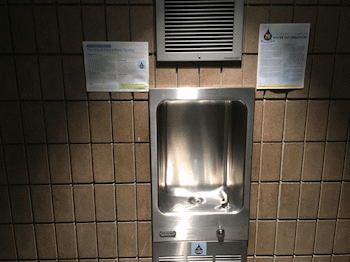 |
| Water notices posted beside a drinking water fountain in Flint, Mich. © Photo courtesy of James Bruggers. |
The public joined us for a community conversation about important regional and national environmental and health issues, and a potential conference and reporting project. The event, organized by SEJ with the University of Michigan-Flint, began with an informal reception, followed by the program and Q&A with SEJ board members Jeffrey Burnside (president), Elizabeth Grossman and Susan Moran.
Featured speakers included:
- UM-Flint Chancellor Susan E. Borrego
- Dr. Mona Hanna-Attisha, director of the Michigan State University and Children’s Hurley Hospital Pediatric Public Health Initiative
- Curt Guyette, ACLU investigative reporter
Coverage:
- Sound recording of the event (MP3/30.4MB/01:28:37)
- Video on Periscope: Part 1 (00:38:34) | Part 2 (00:18:02) | Part 3 (00:12:05)
- "Environmental journalists from around nation talk water crisis in Flint," MLive.com, July 22, 2016, by Michael Kransz.
- "Keep the heat on the Flint story, UM-Flint Chancellor and residents tell national journalists," East Village Magazine, July 26, 2016, by Jan Worth-Nelson.
- "Flint water crisis 'a shocking denial of what should be a right,' NRDC expert tells visiting scribes," East Village Magazine, July 26, 2016, by Jan Worth-Nelson.
Around the Environmental World with SEJ
March 3, 2016
Journalists who wanted to get the scoop on The Pew Charitable Trusts’ ocean initiatives and question experts from Climate Nexus and the Walton Family Foundation on what they’re working on for the next few years joined the Society of Environmental Journalists and The Pew Charitable Trusts in Washington, DC for an evening of hors d’oeuvres and environmental chatter. Details.
The Year Ahead in Environment and Energy: Stories to Watch in 2016
February 11, 2016
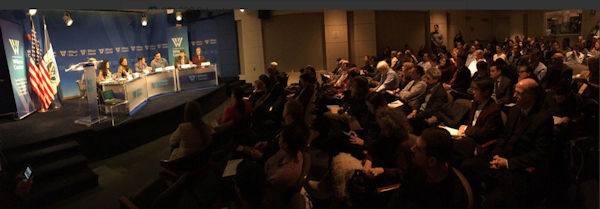
As the Paris climate agreement rolls out, the U.S. presidential race speeds up, and the Supreme Court weighs in, 2016 is already a banner year for environment and energy news. On February 11, the Society of Environmental Journalists and the Wilson Center's Environmental Change and Security Program presented our fourth annual “Year Ahead in Environment and Energy” event in Washington, DC. Leading reporters and editors discussed breaking news from the Supreme Court, climate accord prospects and other critical issues of 2016.
- See details of the event here.
- Watch the webcast recap here. See photos here.
- "So This Is What Could Happen in 2016 in Environmental Policy News," Energy and Environment blog, Bloomberg BNA, Feb 11, 2016.
Digital Terrain: Navigating the New World of Environmental Storytelling
July 10, 2015
 Environmental journalists are charting a new digital terrain, but this changing media landscape can be tough to navigate. A packed venue of attendees explored emerging forms of environmental storytelling — online video and long-form narratives, data visualization, podcasting, social media, and more — at a day-long workshop sponsored by SEJ at City University of New York Graduate School of Journalism.
 Sacramento: Big Think for SEJ 2016
April 17, 2015
Sacramento’s Capital Public Radio, in partnership with UC Davis, is hosting SEJ’s 2016 annual conference and this past April we reached out to our Northern California members to help us start shaping the agenda. We met 3:00-5:00 p.m., Friday, April 17, 2015, in Sacramento, for a conversation with regional leaders about the most pressing environmental issues of the day.
The Year Ahead in Environment and Energy: Stories to Watch in 2015
January 23, 2015
For the third year in a row, the Society of Environmental Journalists held a public discussion at the Woodrow Wilson Center for International Scholars in Washington, DC. The event ran from 3:00-5:00 p.m., followed by a reception. SEJ Board President Jeff Burnside introduced leading reporters and editors, who offered their predictions on the critical energy and environmental stories that will shape 2015. The event was also webcast live.
- Watch the entire archived webcast (2:04:51) or the highlights below (00:06:22).
- "Reporters Predict Contentious Year Ahead for Environment and Energy," New Security Beat blog, Wilson Center, February 18, 2015, by Sarah Meyerhoff.
- Event details.
- Download the flyer.
Toronto, Canada Meet-up
November 26, 2014
Washington, DC Meet-Up
November 17, 2014
 |
|
The group visited Pleasant Valley Farm, a hub in the Saratoga region's local food movement, where they were treated to hearty soup and bread, and a tour of the farm's operations. Click to enlarge. © Photo by Madeline Bodin |
Saratoga Springs, NY Meet-up
November 10, 2014
An intimate group of journalists explored food issues and sustainability in a regional meet-up in Saratoga Springs, NY on Nov 10th. They visited Pleasant Valley Farm, a hub in the Saratoga region's local food movement. They also learned about Saratoga Spring's recent revitalization and development issues from SEJ member Dale Willman. They then dove into the scientific, agricultural and political aspects of GMOs with an expert panel. The meet-up also served as an introduction to SEJ for media members registered for the Northeastern Sustainable Agriculture Working Group conference taking place at the same time.
Many thanks to Dale Willman and our northern-New England meet-ups leader Madeline Bodin for arranging this terrific opportunity for journalists! Connect with SEJ-led meet-ups in your region here.
SEJ/Poynter Science and Environmental Journalism Workshop
November 3, 2014
In St. Petersburg, Fla on Nov 3, 2014, SEJ and the Poynter Institute co-sponsored a comprehensive day of learning how to pitch, investigate and craft compelling science-based stories in a competitive media landscape to accurately inform the public while keeping them engaged. SEJ members and students received a discount.
McCormick Specialized Reporting Institute on Shale Gas and Oil Development
June 22-24, 2014
 The Society of Environmental Journalists invited U.S. journalists and educators to participate in an expenses-paid McCormick Specialized Reporting Institute on Shale Gas and Oil Development in Pittsburgh, PA, to learn about an issue that regularly grabs national, regional and local headlines. More information, including the list of successful applicants awarded fellowships. See resources resulting from this event here.
Freelance Pitch Slam & Meet-Up
April 11, 2014
 SEJ and Capital Public Radio provided an opportunity Apr 11, 2014 in Sacramento for those with an environment-related story or a book proposal to get feedback on their ideas and meet up with fellow SEJ members. Each person had two minutes to pitch stories to a panel of news and magazine editors and three minutes to pitch book ideas to a publisher’s representative. Details here.
SHOWTIME's "Years of Living Dangerously" — Preview and Discussion Event for SEJ Members
April 2, 2014
 "YEARS" is a documentary series, airing exclusively on SHOWTIME beginning Sunday, Apr 13, 2014, where "Hollywood’s brightest stars and today’s most respected journalists explore the issues of climate change and bring you intimate accounts of triumph and tragedy." SEJ members were invited to an exclusive online preview screening and subsequent discussion and Q&A on Apr 2, 2014 with Executive Producer David Gelber, YEARS Correspondent + Executive VP of Conservation International M. Sanjayan, and Chief Science Advisors Heidi Cullen, Ph.D.,and Joe Romm, Ph.D., moderated by Peter Dykstra, Publisher of DailyClimate.org and Environmental Health News. If you missed it, go here for the trailer video, an overview of the series, bios, FAQs, extras, and show schedule.
The Year Ahead in Environment and Energy: Stories to Watch in 2014
January 24, 2014
 SEJ and Woodrow Wilson Center’s Environmental Change and Security Program presented the 2nd Annual Year Ahead in Environment and Energy event, in Washington, DC and as a live webcast. Bloomberg BNA's Larry Pearl began with an overview of the key legislative, regulatory, and legal developments expected in 2014, followed by a roundtable with six top journalists covering local, national, and international environmental issues, moderated by Douglas Fischer, editor of The Daily Climate.
SEJ Members Talk About Environmental Journalism at University of California, Davis Law School Event
September 10, 2013
"Meeting the Challenges of Environmental Journalism in the 21st Century”
 |
| Chris Bowman |
This event was hosted by the UC Davis California Environmental Law & Policy Center and the Policy Institute for Energy, Environment and the Economy for the Fall 2013 Speakers' Series.
The first event in the CELPC Fall 2013 Speakers' Series featured a panel on Environmental Journalism with four esteemed journalists. These panelists have reported on environmental events and issues for local, state, and national news organizations. During this panel they offered their perspectives and insights on reporting in this fascinating area within the overall landscape of journalism and public discourse on the environment.
The moderator was Chris Bowman, Communications Director at the UC Davis Center for Watershed Sciences. Featured panelists were SEJ members Amy Quinton, reporter at Capitol Public Radio; Fiona Smith, reporter from The Daily Journal; and Matt Weiser, the Water and Environment Journalist to The Sacramento Bee.
Translating Science/Telling Stories: “Bringing Climate Change Closer to Home”
June 23-25, 2013
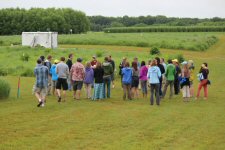 |
| Researchers at MSU’s Kellogg Biological Station explain to scientists and reporters how agriculture affects climate change and could mitigate its impact. Photo courtesy MSU. |
The Society of Environmental Journalists, Michigan State University's Knight Center for Environmental Journalism, the Kellogg Biological Station's LTER and the Institutes for Journalism and Natural Resources recently organized a workshop for scientists and journalists to better communicate climate change information to the public. This is the third in a series of Translating Science/Telling Stories events; see June 9 and July 9-10, 2012 below.
A write-up of this extremely productive two-and-a-half day event is here.
As part of this National Science Foundation-funded effort, the Knight Center has produced a series of short videos. The first group is of scientists and journalists reflecting on their roles, challenges and interaction. The second group features research on climate change journalism. The third group features lectures on Great Lakes-oriented climate change science.
You can find the videos here.
Please feel free to use them in any outreach/educational capacity. If you do, it's helpful to us to know how they are used: sej@sej.org with cc to David Poulson, Associate Director, Knight Center for Environmental Journalism, Michigan State University.
SEJ Toronto Pub Night Series 2013
SEJ Pub Nights take place in Toronto, Ontario, Canada as members are moved to get together,. Sometimes we invite a guest speaker for a brief, informal conversation about an area of interest. We welcome journalists who cover environmental issues, or who wish to, as well as journalism students, academics, and other interested parties. The goal is to get some useful information and have ample opportunity to chat about environmental journalism amongst ourselves. See past get-togethers: 2012 | 2011 | 2010 | 2009.
June 11, 2013: The Mugshot Tavern on Bloor West near Keele on Tuesday, June 11 at 7:00 p.m. It's kitty corner from High Park.
Pub events are free, but space is limited, so please RSVP: soosthoek@gmail.com
Want to get involved in the Toronto pub nights, either organizing, attending, lining up speakers or being a speaker? Contact SEJ member and freelance writer/editor Sharon Oosthoek.
Food + Agriculture Media Project (F+AMP) Explores Issues of Food Writing and Sustainability
April 12, 2013
 Food issues with broader social implications — environment, equity, economics — were the focus of a one-day writers workshop held at Ecotrust in Portland, Oregon, on April 12, 2013. The Food + Agricultural Media Project (F+AMP) aims to provide food and agriculture reporters, bloggers and writers with new ways to craft stories that engage audiences through food coverage.
F+AMP, in partnership with the Society of Environmental Journalists (SEJ) and Ecotrust, featured keynote speaker Adriene Hill, reporter for American Public Media’s Marketplace. Hill kicked off the day with a discussion of how she integrates food and sustainability into her reporting for public radio. Breakout sessions included using food as a framework to report on national and local stories, reporting and writing opportunities in a shifting media landscape, and a case study exploring the complexity, controversy and economics of meat — from production and processing to sales.
"A Fierce Green Fire" Online Forum
February 1, 2013
 SEJ and the Environmental Film Festival in the Nation's Capital invited SEJ members to an online event Feb 1, 2013. Members were able to preview beforehand "A Fierce Green Fire," a sweeping history of the environmental movement by Oscar-nominated filmmaker Mark Kitchell, inspired by a book of the same name written by SEJ co-founder Phil Shabecoff, author, former environmental correspondent for the New York Times and founding publisher of Greenwire. Then, on the day of the forum, those signed up were able to dial in to the conference call.
- Listen to the audio recording of the conversation with Shabecoff and Kitchell.
- Read details about the event here.
The Year Ahead in Environment and Energy: Stories to Watch in 2013
January 25, 2013
A panel of veteran journalists, hosted by SEJ and the Wilson Center's Environmental Change & Security Program, offered their thoughts on what will be the biggest environment and energy stories in the U.S. and around the world on January 25th, 3-5 p.m. in Washington, DC. The event was also webcast live. Bloomberg BNA's Director of Environmental News John Sullivan kicked off the discussion with an overview of the key legislative, regulatory, and legal developments expected in 2013. Margie Kriz Hobson of E&E Publishing's EnergyWire moderated.
Your Work in Seven Words: Inaugural Gathering of SEJ NYC
November 28, 2012
 This unofficial SEJ NYC group seeks to build and sustain the professional ties between environmental journalists and editors in all media, who live and/or work in the New York City metro area.
The group first met at 7:00 p.m. on November 28, 2012.
The challenge was: Come prepared to tell everyone about your work *in just seven words*.
Sign up for the group to be notified of future gatherings:
Join the group or contact the organizers to learn more.
California's Cap-and-Trade Program — What Journalists Need to Know
October 29, 2012

 The Donald W. Reynolds National Center for Business Journalists and SEJ presented a free webinar on California’s greenhouse gas emissions cap-and-trade program, which starts Nov. 14. Don’t miss this informative, hour-long webinar with University of California, Los Angeles economist Matthew Kahn. The archived webinar and PowerPoint presentation are available here, as well as handouts (under Additional Resources).
Beyond Seven Billion: Reporting on Population, Environment, and Security
October 9, 2012
 From his research and travels to report "Beyond Seven Billion," a landmark five-part series published in the Los Angeles Times, reporter Kenneth R. Weiss shared his stories about the impact of population growth on natural resources, food supply, and conflict in Afghanistan, India, Kenya, China, and the Philippines — and the challenges of covering this complex topic. Sponsored by the Environmental Change and Security Program, the Society of Environmental Journalists, the Africa Program, and the Asia Program in Washington, DC. Couldn't attend in person? The archived webcast is available here.
Translating Science/Telling Stories: “Agriculture, Water Quality & Changing the Climate Conversation”
July 9-10, 2012
Co-sponsored by the Society of Environmental Journalists and the Knight Center for Environmental Journalism at Michigan State University, with funding from the National Science Foundation
A Fellowship Opportunity for Journalists AND Scientists
Translating Science/Telling Stories: "Agriculture, Water Quality & Changing the Climate Conversation" took place July 9-10, 2012, at the Kellogg Biological Station in Hickory Corners, MI.
 The scientific community has spoken loud and clear – anthropogenic climate change is here, it’s affecting our world and worse impacts are on the way. Across the globe, people grapple with climate change impacts and governments, municipalities and insurance companies scramble to prepare for sea-level rise, extreme rainfall, droughts and wildfire. Despite all of this, political and public concern has nearly evaporated.
What happened? How can this disconnect be explained? And how can journalists and scientists raise the level of discussion in this "age of information" without compromising their professional objectivity?
U.S. journalists and scientists who were awarded fellowships joined us at the Kellogg Biological Station for a two-day workshop exploring this issue. Participants went out in the field to hear about climate change and Great Lakes agriculture impacts, boarded boats to talk about the threat to inland waters and hunkered down with small groups of their scientific and journalistic colleagues to talk about the promises and pitfalls inherent in creating new ways of connecting with their intended audiences and getting climate change back on the radar.
FREE WEBINAR: Understanding the Body Burden: Using Human Testing in Environmental and Health Storytelling
June 19, 2012
 Co-sponsored by the Society of Environmental Journalists and Reporting on Health
WHEN: June 19, 2012, 10:00-11:00 a.m. PST (1:00-2:00 p.m. Eastern)
WHERE: Your computer
It’s not easy for journalists to undertake testing on humans, nor should it be. But testing for the body burden — the human body’s levels of chemical pollutants that can cause cancer, birth defects and other problems — can add powerful context to health and environmental storytelling. In this hour-long webinar, you’ll get ideas and tips from two veteran environmental journalists, Douglas Fischer and Janet Wilson, who have used biomonitoring in their work.
Translating Science/Telling Stories: “What We Talk About When We Talk About Climate Change”
June 9, 2012
Co-sponsored by the Society of Environmental Journalists and the Knight Center for Environmental Journalism at Michigan State University, with funding from the National Science Foundation
A Fellowship Opportunity for Journalists AND Scientists
 While communities across America grapple with climate change impacts and prepare for rising seas, intense storms, and record-setting droughts, civic concern and media coverage about climate change are on the decline.
The Translating Science/Telling Stories project brings scientists and journalists together to discuss ways to better help the public appreciate the risks and understand the choices they, their communities, and their governments face.
For the first event, “What We Talk About When We Talk About Climate Change,” journalists and scientists awarded fellowships came Saturday, June 9, 2012 to the Great Lakes Science Center in Cleveland, OH to hear about the latest in Great Lakes climate research, develop working relationships with colleagues and counterparts, and take a seat at the forefront of envisioning a new model of climate change communication.
The Questions that Should be Asked: Environment, Energy, and Natural Resources in the Presidential Race
April 16, 2012
Co-sponsored by the Society of Environmental Journalists and the Environmental Law Institute

 Although environmental, energy, and natural resource policies have seldom figured prominently in a presidential election, such policies have a direct effect on issues that do feature prominently in presidential elections. For example, energy policy alone affects public health, foreign policy, and the domestic economy. As a companion to ELI's Environmental Forum article which surveyed 12 major figures on what topics should be discussed in the presidential debates, five experts with broad policy experience were invited to discuss their answers to two key questions. First: "What should the presidential candidates discuss concerning the important issues of environment, energy, and natural resources facing the people of the United States?" Second: "What questions should be asked of candidates in the presidential debates that will help us learn how they will confront these issues?" Please note: this discussion was designed solely to frame the questions—not to answer them.
The event took place April 16, 2012, 5:30-7:00 p.m., in the Murrow Room of the National Press Club, 529 14th Street NW, Washington, DC.
Speakers:
- Dina Cappiello, National Environment Reporter, Associated Press (moderator)
- John Cruden, President, Environmental Law Institute
- Bob Deans, Associate Director of Communications, Natural Resources Defense Council
- E. Donald Elliott, Professor (Adjunct) of Law, Yale Law School
- Kenneth P. Green, Resident Scholar, American Enterprise Institute
- Jacqui Patterson, Director, Environmental and Climate Justice Program, NAACP
SEJ Toronto Pub Night Series 2012
SEJ Pub Nights take place as members are moved to get together, usually in the upstairs bar at Harbord House in Toronto, Ontario, Canada. Sometimes we invite a guest speaker for a brief, informal conversation about an area of interest. We welcome journalists who cover environmental issues, or who wish to, as well as journalism students, academics, and other interested parties. The goal is to get some useful information and have ample opportunity to chat about environmental journalism amongst ourselves. See upcoming dates. See 2011 speakers. See 2010 speakers. See 2009 speakers.
March 6, 2012: Members of SEJ and the Canadian Science Writers' Association held a pub night to chat about science and environmental issues from a journalistic point of view.
Access Denied: Science News and Government Transparency
October 3, 2011
Has the Obama administration lived up to its promise to make science more transparent and accessible to the public? An investigation in the current issue of Columbia Journalism Review (CJR) finds that despite President Obama’s early promise to create an open government, the nation’s science reporters feel there has been little to no progress since the Bush administration.
On Oct. 3, from 3 to 5 p.m., the National Press Club (529 14th Street NW, Washington, D.C) hosted a panel of journalists and invited administration officials to critique what journalists and the government are (or aren’t) doing to change that. The event was also livestreamed.
Moderator: Seth Borenstein, Reporter, The Associated Press
Speakers included:
- Curtis Brainard, CJR science editor
- Joseph Davis, Society of Environmental Journalists (SEJ)
- Felice Freyer, Association of Health Care Journalists (AHCJ)
- Clothilde Le Coz, Reporters Without Borders energy and environment reporter
- Darren Samuelsohn, Politico’s senior energy and environment reporter
- Nancy Shute, National Association of Science Writers
Representatives of the Environmental Protection Agency, the Department of Health and Human Services and the White House Office of Science and Technology Policy were invited. None participated.
The panel discussion was co-sponsored by the National Press Club, CJR, SEJ, and Reporters Without Borders.
- Watch NPC's video of the event on YouTube (2:03:20).
- "Obama Administration not delivering on its promise of open government, journalists say," National Press Club, October 4, 2011, by John Hughes.
- "Government obstructing access to science data, panel says," News Media Update, Reporters Committee for Freedom of the Press, October 4, 2011, by Kirsten Berg.
- "Science News and Government Transparency," October 4, 2011, Storified by Pia Christensen of the Association of Health Care Journalists.
- "An Empty Seat: Government fails to show for science news, transparency event," The Observatory, Columbia Journalism Review, October 12, 2011, by Curtis Brainard.
SEJ Toronto Pub Night Series 2011
SEJ Pub Nights took place the first Tuesday of the month, September through April, usually in the upstairs bar at Harbord House in Toronto, Ontario, Canada. Each month we invited a guest speaker for a brief, informal conversation about an area of interest. See 2010 speakers. See 2009 speakers.
September 6, 2011: Pete Wobschall, executive director of Hamilton-Wentworth Green Venture.
April 5, 2011: Jim Stanford, economist with the CAW and author of Economics for Everyone: A Short Guide to the Economics of Capitalism.
March 5, 2011: Ravenna Alnuaimy-Barker, executive director of Sustain Ontario.
February 1, 2011: John Eyles, geography professor at McMaster University in Hamilton, Ontario. Prof. Eyles' research has included environment and health phenomena, and "the geography of everyday life."
Environment 101 for Freelancers
April 14, 2011
SEJ and the Professional Writers’ Association of Canada presented a panel at the University of Toronto, moderated by freelance journalist Saul Chernos. Experienced journalists from both the reporting and the editing sides of the business discussed strategies the country’s top environmentally-minded writers are using to tell and sell their stories. Panelists included Victoria Foote, director of communications for Ontario Nature; independent journalist Stephen Leahy; and Sharon Oosthoek, a Toronto-based freelance science and environmental journalist.
Oil Spill Film & Panel Discussion
University of California, Santa Barbara
January 28, 2011
The Society of Environmental Journalists, in conjunction with the Bren School of Environmental Science & Management at UCSB and the Carsey-Wolf Center at UCSB, presented a public event:
"The Spills: Mixing Oil and Water," a public film screening and panel discussion on the evening of Friday, January 28, 2011, at the Pollock Theater, UC Santa Barbara.
Marking the 42nd anniversary of the Santa Barbara oil spill, leading members of the Society of Environmental Journalists joined scientists from UC Santa Barbara and the University of Louisiana at Lafayette to discuss the societal and ecological impacts of major spills that have fouled the California, Alaska and Gulf coasts. Significant oil and gas reserves lie off U.S. coastlines, but tapping them means drilling deeper in colder, rougher waters. In that context, panelists reviewed the past and provided glimpses of the possible future.
The event opened with a screening of "The Spill," a joint investigation by FRONTLINE and ProPublica into the trail of problems — deadly accidents, disastrous spills, countless safety violations — that had long troubled oil giant BP prior to the Deepwater Horizon disaster. After the film, Bren School dean Steve Gaines and NBC Miami reporter Jeff Burnside co-moderated a panel discussion that included the following participants:
- Abrahm Lustgarten, ProPublica journalist and one of two journalists who reported for The Spill
- Robert Gramling, professor of sociology, University of Louisiana at Lafayette; author of Blowout in the Gulf: The BP Oil Spill Disaster and the Future of Energy in America
- David L. Valentine, professor of microbial geochemistry, UC Santa Barbara, who spent six weeks on the Gulf coast in the aftermath of the spill
- Bettina Boxall, environmental reporter for the Los Angeles Times
- Jim Detjen, Director, the Knight Center for Environmental Journalism, Michigan State University
SEJ Toronto Pub Night Series 2010
SEJ Pub Nights took place the first Tuesday of every month, September through April, in the upstairs bar at Harbord House in Toronto, Ontario, Canada. Each month we invited a guest speaker for a brief, informal conversation about an area of interest. See 2009 speakers.
December 7, 2010: Shelagh Grant, Trent University history professor and author of Polar Imperative: A History of Arctic Sovereignty in North America.
November 2, 2010: Alanna Mitchell, long-time Globe science writer and winner of the Grantham Prize for her recent book, Sea Sick: The Hidden Crisis in the Global Ocean.
September and October, 2010: No guest. Informal gatherings.
April 6, 2010: Sarah Elton, Toronto journalist, CBC radio foodie and author of Locavore: From Farmers' Fields to Rooftop Gardens — How Canadians Are Changing the Way We Eat (HarperCollins, 2010).
March 2, 2010: Steven Peck, president of Green Roofs for Healthy Cities.
February 2, 2010: Jamie Benidickson, University of Ottawa law professor and author of The Culture of Flushing: A Social and Legal History of Sewage (UBC Press, 2007).
Climate and Sustainability: Moving by Degrees
Wednesday, June 9, 2010
Presented by Marketplace and The Gary Comer Global Agenda, The Kendeda Fund and the Society of Environmental Journalists.
 Climate and Sustainability: Moving by Degrees was a national, interactive, day-long symposium that brought the nation's top scientists, policymakers and business leaders together with reporters from public radio and commercial stations from around the nation.
Participants included:
- Dr. Michael E. Mann, Pennsylvania State University
- Dr. Benjamin Santer, Lawrence Livermore National Laboratory
- Stewart Brand, founder of the Whole Earth Review
- Andrew Revkin, award-winning New York Times Dot Earth blogger
- Joe Romm, Center for American Progress and ClimateProgress.org blogger
- Dr. Stephen Schneider, Stanford University
- Elizabeth Kolbert, award-winning staff writer at The New Yorker
This online event was aimed at bringing together journalists and the public online and at Southern California Public Radio's (SCPR) Crawford Family Forum to decipher fact from fiction, to learn how our scientific understanding has evolved, and to understand where politics, science and business agree and diverge on how to create a sustainable future. Watch archive video from the day-long symposium.
Agriculture and Food Security in 2050
January 22, 2010
A public event co-sponsored by the Society of Environmental Journalists and Texas Tech University Institute of Environmental and Human Health.
Texas Tech University scientists and environmental journalists explored some of the daunting environmental challenges farmers in West Texas face on the evening of Friday, January 22, 2010, in the Texas Tech University's Hall of Nations, International Cultural Center, 601 Indiana Avenue, Lubbock, Texas.
Climate change impacts, water supply and quality, and pesticides/chemicals were among the topics discussed at the event.
Dallas Morning News reporter Randy Lee Loftis moderated the discussion.
Texas Tech University representatives on the panel:
- John Zak, Associate Dean of Research for Arts and Science
- John Burns, Dean of Agriculture
- Ron Kendall, Director and Chair of the Institute of Environmental and Human Health
Journalists on the panel:
- Rob Davis, Voice of San Diego
- Douglas Fischer, DailyClimate.org
- Cheryl Hogue, Chemical & Engineering News
Covering Climate: What's Population Got to Do With It?
October 14, 2009
Co-sponsored by Woodrow Wilson International Center for Scholars' Environmental Change and Security Program, Society of Environmental Journalists, and the International Reporting Project.
Dennis Dimick, executive editor of National Geographic Magazine; Emily Douglas, web editor of The Nation; and Andrew Revkin, environmental reporter with The New York Times, offer ideas and best practices for stories on population-climate links.
- Session information and video (1hr:54:27).
SEJ Toronto Pub Night Series 2009
SEJ Pub Nights took place monthly at Harbord House, Toronto, Ontario, Canada. Each month we invited a guest speaker for a brief, informal conversation about an area of interest.
December 1, 2009: Gideon Forman, executive director of the Canadian Association of Physicians for the Environment. Gideon has a long history in the Ontario environmental movement, with some very notable work on getting municipalities to ban cosmetic pesticides.
November 3, 2009: Bill Kovarik, a Radford University journalism professor and SEJ board member. Kovarik is spending a year in London, where he's teaching Environmental Journalism in the graduate journalism program at the University of Western Ontario.
October 6, 2009: Thomas Pawlick. A veteran journalist and former Harrowsmith editor, Pawlick has won a National Magazine Award and three CSWA awards for his work. He discussed his new book, The War in the Country: How the Fight To Save Rural Life Will Shape Our Future.
September 1, 2009: Stephen Boles, founder of Kuzuka.com, a new company that is doing for the retail carbon credit market roughly what Expedia did for air travel. He's spent the last couple years plunging into the carbon markets and studying the standards. He's also a GIS expert whose other company primarily serves Canadian vineyards. Before that, he worked at the Institute for Earth, Oceans and Space at the University of New Hampshire, studying the effects of land use on greenhouse gas emissions.
August 4, 2009: No speaker. Participants relaxed and chatted about what we'd like to see happen in the next year or two.
May 5, 2009: Ravenna Barker, an urban agriculturalist with Foodshare Toronto.
April 7, 2009: Cara Sloat, a professional engineer and designer with Cobalt Engineering. Cara is a green building specialist whose project experience ranges from single off-grid houses to shopping centres and office towers. T'was a great night for those who write about real estate, environmental design or retail.
March 3, 2009: Jane Story, Manager, Policy & Communications, Ontario Sustainable Energy Association. Hot on the heels of Ontario's Green Energy Act announcement comes an opportunity to explore the background informally with one of the proponents. Jane has been involved in environmental issues for many years, first as a reporter for NOW Magazine in the early 80's and more recently as communications officer for Greenpeace Canada and WWF Indochina. She also has extensive experience working with indigenous people in Canada, where she established a communication office for the United Chiefs and Councils of Manitoulin, and overseas, working in Papua New Guinea, Lao, Vietnam, Cambodia, Palestine and the Solomon Islands, where she was employed by the United Nations Development Program. Jane earned her Hon. B.A. in English from the University of Guelph and studied photography at the Polytechnic of Central London (England).
Selected past regional events from 2008 and earlier are archived here, on SEJ's old site.
Initiatives:
Topics on the Beat:
Visibility: