


SEJournal Online is the digital news magazine of the Society of Environmental Journalists. Learn more about SEJournal Online, including submission, subscription and advertising information.
January 21, 2026
 |
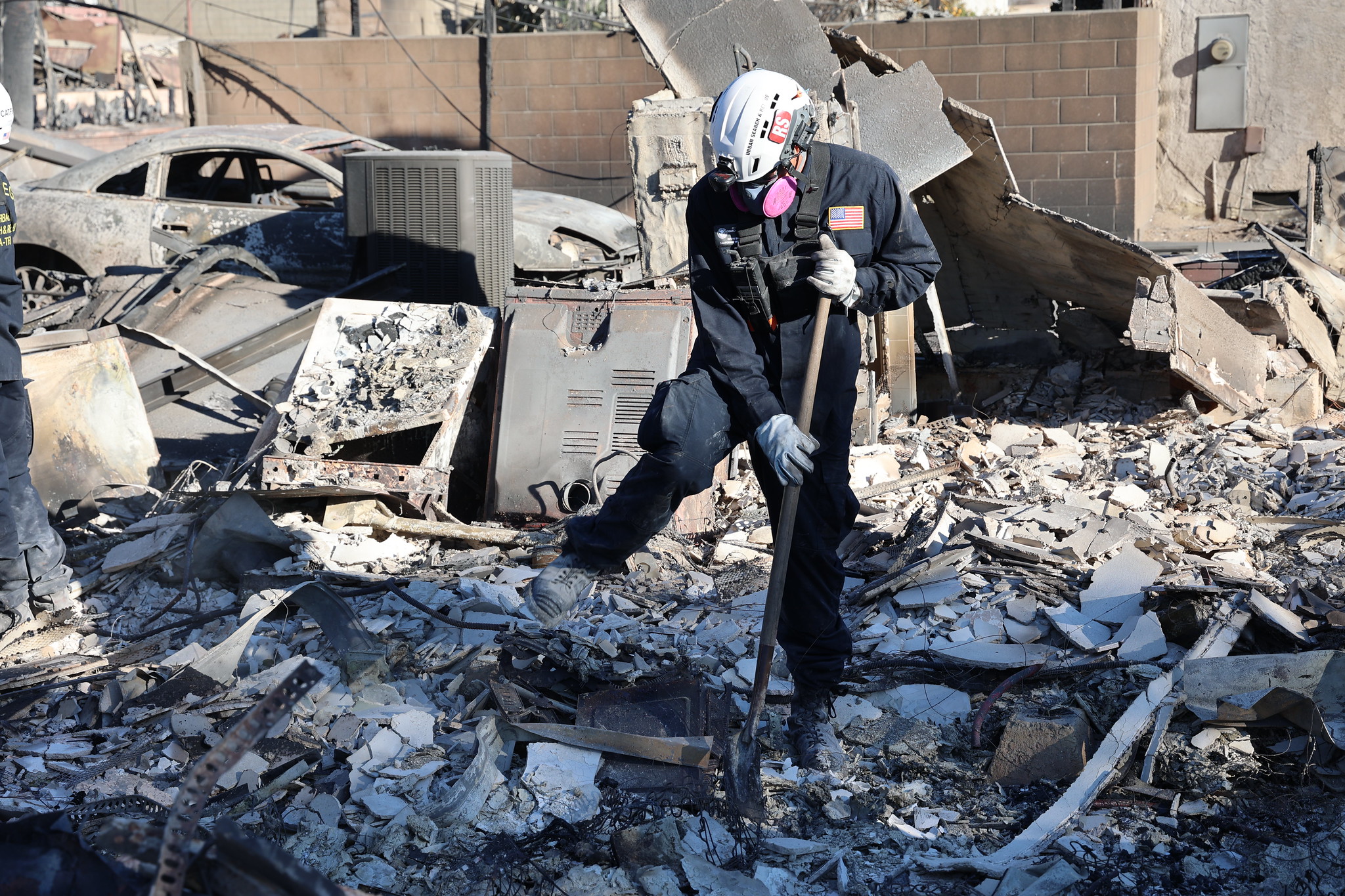 |
| Cleanup after the Eaton Fire in Los Angeles County, California, in January 2025. One journalist focused her fire reporting on a solutions-oriented story about a volunteer program involving community members. Photo: CAL FIRE_Official via Flickr Creative Commons (CC BY-NC 2.0). |
Voices of Environmental Justice: Solutions Stories a Compass for Readers
Since mid-2023, journalist Yessenia Funes has graced the pages of the SEJournal with her column, Voices of Environmental Justice, spotlighting the perspectives of affected communities that environmental and climate journalists often ignore. Now, we’re bringing our readers more of Voices, as the climate-focused column moves from a quarterly to a bimonthly cycle.
“There’s never been a more urgent need for intersectional reporting on climate change and environmental issues,” Funes observes. “Now, more than ever, the field needs to hear from front-line voices and all the diverse communities experiencing pollution and disaster. Climate connects to everything: politics, immigration, culture, history, identity. I’m excited to share more insight with my peers.”
Enjoy!
By Yessenia Funes
In the first days of 2025, Colleen Hagerty pitched a story on Community Brigade, a California volunteer program to help build local wildfire response and preparation.
The very next day, Los Angeles broke out in several blazes that would mark one of the deadliest and costliest extreme weather disasters in U.S. history. Her story was published in Bloomberg CityLab two months later.
“The timing of it was actually really strange,” said Hagerty, a disaster-focused freelance journalist based in LA.
One key facet of the piece set her reporting apart: its solutions lens. While she shifted gears to focus on the Palisades Fire, her original idea was still relevant. After all, these blazes would put the volunteer program to the test.
As others wrote about
the losses, Hagerty shed
light on the neighbors
who sprang into action.
As others wrote about the losses, Hagerty shed light on the neighbors who sprang into action — the everyday people who helped save lives.
“There are people who are really working 24/7 behind the scenes to try to be prepared for these types of events,” Hagerty said. She wanted to capture that side of the story — the community, the camaraderie, the compassion. “That’s really important in order to tell the true and full story of what’s happening on the ground.”
And that’s what solutions journalism is about: telling the complete story. These climate angles are itching to be told, but journalists can be quick to dismiss or overlook them because of our own biases.
Well, what about our readers? Sure, they need the news, but they need joy, too. They need a compass to point them home. They need hope.
Let’s make 2026 the year that climate and environmental reporters lean into solutions narratives. And I’m not talking fluff. I’m talking about examples of measurable and impactful change. Solutions reporting can be hard-hitting and data-driven. It can hold the powerful accountable.
In a media ecosystem where we excel at illustrating failures and setbacks, shouldn’t we also learn to remind readers how beautiful, deserving and successful people can be, too?
What is solutions journalism?
Hagerty became an expert on solutions reporting after completing a 2023 fellowship with the Solutions Journalism Network (which I work with). The network is the leading international voice on the subject. The organization defines solutions journalism as “rigorous and compelling reporting about responses to social problems.”
At SJN, Hagerty discovered solutions journalism’s four pillars: response, insight, evidence and limitations. If a story includes all four, a reader should walk away with a clear understanding of a solution’s strengths, weaknesses and ability to be reproduced.
You can also avoid succumbing to corporate greenwashing by upholding a solution that doesn’t actually work.
“Out of this whole decade or more of experience, these four have stood out as the key pillars or benchmarks of what makes a good story,” said Angela K. Evans, SJN’s director of communities of practice, who has worked on the organization’s climate initiatives since 2023.
A solutions story should focus on a response, not a problem. If your article (or any other medium) only briefly mentions a solution while going on and on about a problem, that’s not a solutions story.
A good solutions piece should also leave readers empowered. It should give them a roadmap to do something similar if they’re curious. That’s where insight comes in: how the people behind the solution made it possible.
Evidence is the trickiest and,
arguably, most important pillar.
You need to show readers
that the solution works.
Evidence is the trickiest and, arguably, most important pillar. You need to show readers that the solution works — or, if you’re debunking a solution, why it doesn’t. Solutions journalism can and should do both.
Lastly, limitations. No solution is perfect. Sometimes, a program is too expensive, like the Community Brigade Hagerty wrote about. Or perhaps it creates a new problem. Or maybe it excludes a certain group of people. Solutions stories don’t shy away from that.
“We see so many promises, whether from industry or governments or even communities, that really don’t have any teeth behind them or metrics behind them that show they work,” Evans said. “While we do believe solutions journalism provides hope, we don’t want to provide false hope.”
‘A better way to do journalism’
Kathryn Thier, an assistant professor at Fairleigh Dickinson University in New Jersey, used to be a journalist but pivoted to teaching and research after experiencing a mass buyout and layoff event in 2008.
“I had become interested in solutions journalism when I was still a journalist, but I didn’t know it existed,” she shared. “I just knew there had to be a better way to do journalism.”
She started one of the country’s first undergraduate solutions journalism courses in 2016 to teach the practice, but that wasn’t enough. She wanted to unpack the science behind solutions journalism. She has since published eight peer-reviewed papers and three book chapters on the matter.
In September, a journal article she wrote found that solutions-oriented climate stories can increase a person’s “positive affect,” which the American Psychological Association describes as the feeling associated with avoiding a threat or feeling satisfied with an outcome. This feeling, however, didn’t always translate into policy support, her study noted.
Separate research has concluded that solutions-focused climate angles can encourage people to take action. Narrative is another tool researchers have discovered can help boost a solutions story’s power on its audience.
Unfortunately, even solutions journalism has its limits, especially when covering something as politically heated as climate change.
“A lot of what we see when we conduct solutions research is that people’s underlying beliefs about climate change are not typically drastically swayed by climate solutions journalism,” Thier explained.
Advice from the experts
Thier advises journalists to lean into climate solutions angles when writing about health. Research has found health to be a powerful subject to draw in otherwise skeptical readers.
Whitney Bauck, a freelance journalist who was an SJN fellow in 2022, has written about food and policy through a solutions lens. She encourages environmental reporters interested in solutions to find creative ways to cover the midterms this year.
With the public focus shifting away from climate change, she’s especially curious what progress on the issue looks like when people aren’t looking.
‘It’s part of our responsibility as
journalists to figure out, especially
on climate, how to get people
to read and engage and plug in.’
— Whitney Bauck, freelance journalist
“Solutions journalism is not just about telling a happy story,” she said. “We don’t want to have a negativity bias where we’re only ever showing people what’s wrong. It’s part of our responsibility as journalists to figure out, especially on climate, how to get people to read and engage and plug in.”
And this responsibility goes beyond the words we write; it also extends to the photos that accompany our work. Justin Cook, a freelance climate journalist and photographer based in North Carolina, recognizes the urgency around transforming the visual approach to climate stories, too.
“So much of our information we get from social media is very visual-first,” he said.
If a solution is visual, that needs to be documented, too. The public needs to see how ordinary people are coming up with their own solutions, particularly to adapt to climate change. This approach can give communities more agency, which is especially critical when writing about environmental justice issues.
“Often in my reporting, the people don't realize that what they’re doing is a climate solution, and that becomes part of the process of the reporting,” Cook said.
And that benefit extends beyond the community. For Hagerty, who frequently covers disasters, solutions stories are necessary to maintain her mental health.
“We look at the world, and there are just so many ways that you can go straight down a rabbit hole and block out the sun,” she said. “It feels both like I’m better serving my sources and the communities I’m covering to tell these stories, but certainly for me, it’s helpful to have my perspective cracked open in this way where I can recognize that things can be done differently.”
That’s a point that echoed across all my interviews. And as a journalist who’s practiced solutions journalism myself, I can speak from experience. We can’t only cover the bad, not when there is actually so much good happening. Those moments need a spotlight, too. You’ll be a better journalist for it — and you’ll sleep a little easier.
For those who are ready to take the leap, here are some tips and resources:
- The Solutions Journalism Network regularly schedules free virtual webinars on the subject.
- The network also has a ton of toolkits available for free on its website.
- Covering Climate Now also has a solutions reporting guide available online. There, you can find examples of solutions stories, too.
- If you want more examples, please read Cook’s story for NC Newsline on Black farmers and soil sovereignty here and Bauck’s piece for the Guardian about local climate champions here.
Yessenia Funes is an environmental journalist who has covered the justice beat for a decade. She publishes a creative climate newsletter called Possibilities. Funes has written for publications like Atmos, Vogue, Vox, New York magazine, The Guardian and more. Her approach to storytelling amplifies the voices of those on the front line of our present-day ecological crises. Her reporting has taken her to the West Bank, remote Indigenous communities in Nicaragua, the hostile desert of the American Southwest and post-Hurricane Maria Puerto Rico.
* From the weekly news magazine SEJournal Online, Vol. 11, No. 3. Content from each new issue of SEJournal Online is available to the public via the SEJournal Online main page. Subscribe to the e-newsletter here. And see past issues of the SEJournal archived here.
SEJ Publication Types:
Topics on the Beat:
Visibility: