


SEJournal Online is the digital news magazine of the Society of Environmental Journalists. Learn more about SEJournal Online, including submission, subscription and advertising information.
January 7, 2026
 |
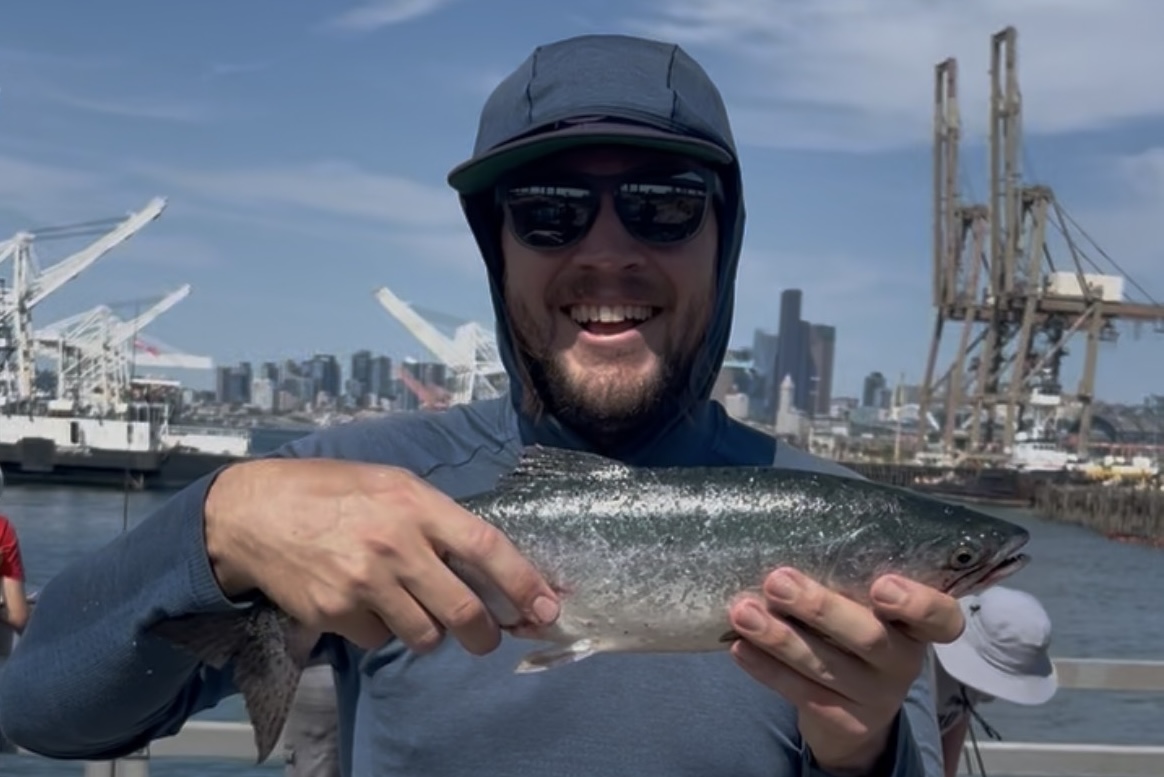 |
| The author with his first pink salmon, caught off a Seattle bridge with the city’s industrial facilities surrounding him. Photo: Courtesy of Alex Brown. |
Feature: Even in This Toxic River — A Salmon Story
By Alex Brown
I caught my first Pacific salmon in a Superfund site.
On a crowded bridge strewn with trash, connected to an artificial island bustling with shipping terminals and industrial facilities, I cast my lure into the oil-slicked surface of Seattle’s Duwamish River.
Below me, the murky water brightened with hints of chrome as a school of pink salmon flashed under the bridge. Anglers called out in a host of different languages, and a dozen fishing lines sailed toward the water, just a beat behind the salmon.
It was an odd-numbered year, which in Washington State means it’s a pink salmon year.
These fish have a two-year life cycle. In rivers and streams all over the state, one generation of salmon journeys to the spawning grounds to lay their eggs and die. A few months after hatching, the tiny smolts travel downstream and swim out to sea. Two years later, they return as adults, packed with muscle and fat from their Pacific Ocean diet, to swim back to the freshwater sites where they were born and breed the next generation.
The pink salmon that pass through Seattle are born in the Green River, which arises on the western slopes of the Cascade Range and plunges through gorges in glittering rapids overhung with mossy trees. As the Green completes its descent to Puget Sound, it becomes the Duwamish, a murky channel bound by concrete, rock piles and steel walls.
The lower portion of the Duwamish has long been the center of Seattle’s industrial activity. The waterway, dredged and straightened in the early 1900s, connected manufacturing plants to the shipping terminals on Puget Sound. The river became a conveyor belt for asphalt, steel and cement — as well as a dumping ground for factories and sewer overflows.
The Duwamish River is
closed to almost all fishing,
because toxic chemicals
accumulate in dangerous levels
in the fish that call it home.
In 2001, the U.S. Environmental Protection Agency declared the Duwamish a Superfund site, starting a cleanup effort that will continue for many decades to come. The river is closed to almost all fishing, because toxic chemicals such as PCBs accumulate in dangerous levels in the fish that call it home.
Salmon are the exception. Because the polluted lower portion of the river is only a short stop on the salmon’s migratory route, they don’t absorb unsafe levels of the toxic substances.
‘Combat fishing’
Fresh from the Pacific Ocean, the salmon squeeze by the shipping terminals on Harbor Island and enter the Duwamish.
On the bridge above, scores of anglers await the salmon bottleneck. Standing shoulder to shoulder, they compete to get their lures in the water and jostle for a chance to harvest the ocean’s bounty as it pulses into this wounded river.
This is what some anglers derisively refer to as “combat fishing” — the humans more packed in than the fish, lines tangling, elbows colliding, general chaos.
But the people pack in for a reason. One, two, three rods double over, and thrashing fish break the river’s still surface. The anglers reel the fish to below the bridge, pull their lines taut and then whip their rods upward, launching the salmon into the air, over the railing and onto the bridge deck.
One morning last summer, I added my own fishing pole to the scene, wedging myself into a narrow space on the bridge and flicking my lure out into the water. A tugboat entered the channel below a forest of cranes. Just beyond the fishing lines, a pair of seals circled, extracting their own toll from the silver caravan of fish. Beyond, the skyline spread across the watery horizon, Seattle’s Great Wheel circling above the downtown waterfront.
I reeled in my line, hoping for a strike.
Salmon fever, frustrated
Since I moved to Washington in 2018, I’ve pursued an on-again, off-again quest to land a Pacific salmon.
Armed with instructional videos from YouTube and fishing reports on message boards, I’ve cast spinners for cohos from the gravel bars of the Cowlitz River and drifted eggs under a bobber from the forested banks of the Nisqually River.
Every year or two, I’d buy new gear from the fishing shop, enthusiasm rising, but my lures always seemed to hook more logs than fish.
Sometimes, the river was just quiet — wrong place, wrong time.
In other cases, I’d watch nearby anglers haul in majestic salmon while I struggled to get a nibble. Even when I copied their gear, some imperceptible difference of technique or luck sent me home empty-handed.
After a few weeks of this, I’d give up and dump my gear in a forgotten corner of the storage room. It would sit there until the salmon fever struck again. Then I’d pull out the tangled lines, mixed-up tackle and dusty reels, the gear still wearing the frustration of my previous failed attempt.
With a new plan and new gear, I’d set out for another river, determined to finally cross paths with one of these ocean beasts on their epic journey.
Alpine inspiration
Last year, I got the itch again.
I spent much of the spring finishing a freelance story about an unusual stocking program that plants rainbow trout in the mountain lakes of North Cascades National Park.
I pondered the values of
ecological integrity and
wilderness recreation,
reckoning with my own
mixed feelings.
I talked to conservationists who are troubled by the alien fish being introduced in pristine wilderness. I talked to anglers who lit up with excitement about catching trout in gorgeous alpine lakes. I pondered the values of ecological integrity and wilderness recreation, reckoning with my own mixed feelings.
Soon after the story published, I hiked to an alpine lake in the North Cascades, fishing pole in hand. Backdropped by snow-covered peaks, I cast a lure into the water, in pursuit of the trout that had been planted by a fishing club a few years before.
Before long, I’d landed a pair of medium-sized rainbows. Despite my reservations about the stocking of non-native fish, I had to admit it was thrilling to hang a line in such a spectacular environment.
After some additional fishing trips to mountain lakes over the summer, I was reminded that pink salmon were about to make their return to Washington. I’d never fished for pinks before, perhaps because much of my fishing took place during even-numbered years when the fish were out at sea.
When they do show up, pinks return by the millions. They’re the smallest of the Pacific salmon species, the easiest to catch and considered somewhat below the others in terms of table fare. Many serious anglers prefer the challenge of targeting the larger, more elusive and tastier Chinooks and sockeyes.
But at that point, I wasn’t about to be a snob.
On the bridge
With nearly 8 million pinks forecast to return to Puget Sound in 2025, I decided to make a bid at the August salmon surge. I spent one Sunday on a beach in north Seattle, hoping to intersect schools of pinks traversing the Sound’s shoreline. Once again, even these “beginner” salmon weren’t biting.
Later that week, my friend Melanie told me she’d seen anglers hauling in salmon from the bridge on Harbor Island. We resolved to brave the crowd for a chance at fishing the massive schools of pinks entering the Duwamish.
We set out early that Sunday. Even at 6 a.m., there was hardly a spot to be found on the bridge.
Instead, we tried our luck on the nearby riverbank, but the slippery, trash-strewn rock piles quickly became jammed with people. After tangling lines with nearby anglers and losing lures to the unseen debris on the river bottom, we decided to abandon our plan and go get breakfast.
Later, as I got in the car to head for home, I decided to make one more stop by the bridge. It was still crowded, but I was able to squeeze in and get my line in the water. Others were still pulling in salmon, but once again, my lure seemed to have a force field around it.
Then — a hard yank, bending my rod over, a second of tension and the line went slack again. I’d failed to hook a fish, but it was a no-doubt strike from a salmon after my lure. That bought me just enough resolve to keep fishing.
Soon after, I got another strike, and this time the line stayed taut. A flash of chrome zigged back and forth at the end of my line. Slowly, I reeled in the salmon, praying my knots would hold. Once I got it below the bridge, I tried to lift it out of the water, but failed to yank hard enough to get it above the railing. Another angler ran over and grabbed my line, pulling the fish in by hand.
The salmon thrashed around on the concrete, amid the bloodstains of countless other fish. Pulling it away from the cigarette butts and fast food wrappers, I quickly put my knife through its spinal cord, sliced the gills to drain the blood and tossed it into my cooler.
Quest completed
I mourned a little that this wild fish, this fierce ocean predator, would end its marathon spawning journey so abruptly amid all this trash and pollution.
But I also felt immense gratitude. Even in this toxic river, even below the warehouses and cranes, these miraculous fish return, the ospreys circle over the seasonal feast and anglers from all different backgrounds crowd in to harvest what the ocean gives back to the land.
Thirty minutes later, I hauled in a second salmon, twice as big as the first. I could hardly believe my success.
Upstream of the bridge,
anglers were casting out
from the shore behind a
scrap metal yard, mounds of
rust towering behind them.
With my cooler full, I headed for home, meandering through the industrial zone. Upstream of the bridge, anglers were casting out from the shore behind a scrap metal yard, mounds of rust towering behind them. Next door, a fleet of garbage trucks pulled into the lot, and the sanitation workers fresh off their shift walked down to the bank, rods in hand, still wearing their high-visibility vests.
I had always pictured my salmon quest ending by a scenic rapid or in a lush valley along a glacier-fed river. I’m glad all my failed trips over the years took me to those places. But the photo of me holding my first salmon features a backdrop of cranes, loading docks and skyscrapers. Scenic or not, the moment was no less meaningful. I’m glad my journey led me here.
Even as salmon stocks dwindle, beset by an endless list of environmental problems, even amid increasingly foreboding reports about our planet’s future, there are still days when the water comes alive with fish, where a massive harvest in all its chaos is shared by seals, ospreys and anglers, where wave after wave of salmon run the gauntlet and swim on toward the spawning grounds. To see this miracle here, in one of the most polluted rivers in the country, was awe-inspiring in its own way.
Soon, I’ll cook up salmon fillets for my friends and tell them how the murky shipping channel teems with fish, how they leap from the water in great flashes, how it teems with people and their shouts and tangled lines and triumphant grins.
[Editor’s Note: For more on the topic, see TipSheets on recreational fishing, seasonal fishing stories, the use of lead tackle, fishing advisories, the expansion of fishing at national refuges, endangered rivers and ice fishing. Also, see Toolboxes on trout streams and climate change and consumption advisories, an Inside Story Q&A on aquaculture and a Backgrounder on ocean overfishing. Plus, track EJToday headlines and other info on fish and fisheries.]
Alex Brown is a writer who covers environmental policy in state governments. He’s won awards for investigative reporting, environmental coverage, feature writing and social equity reporting. He recently launched the Issaquah Alps Wildlife Cam Project, a volunteer program to monitor wildlife in public lands near his home, and writes the newsletter Critter Cams about his wildlife observations. He lives in Issaquah, Washington, with his wife, son and dog.
* From the weekly news magazine SEJournal Online, Vol. 11, No. 1. Content from each new issue of SEJournal Online is available to the public via the SEJournal Online main page. Subscribe to the e-newsletter here. And see past issues of the SEJournal archived here.
SEJ Publication Types:
Topics on the Beat:
Region:
Visibility: