



SEJournal Online is the digital news magazine of the Society of Environmental Journalists. Learn more about SEJournal Online, including submission, subscription and advertising information.
May 14, 2025
 |
 |
| A screenshot of the Pulliam Prize-winning story, “Misplaced Trust,” which last year won first place in the Kevin Carmody Award for Outstanding Investigative Reporting, Small. |
Inside Story: ‘Misplaced Trust’ Aims Big, But Finds Details Make the Difference
A groundbreaking, comprehensive and data-heavy investigation into public institutions that profit from stolen Indigenous land took nearly two years and involved a team of Grist reporters, researchers and photographers to complete. The project went on to win not only the Kevin Carmody Award for Outstanding Investigative Reporting, Small, in the Society of Environmental Journalists’ 23rd Annual Awards for Reporting on the Environment. It also took the Nina Mason Pulliam Award for the “best of the best” among SEJ’s top award winners for 2024.
The project displayed “masterful reporting, graphics and data skills,” judges said, adding that it "sets a new standard for storytelling using data driven analysis in investigative journalism. SEJ noted that Grist made the project’s dataset, methods and tutorials available to other outlets to pursue additional stories.
The five-part series was reported and written by Tristan Ahtone, Robert Lee, Amanda Tachine, An Garagiola and Audrianna Goodwin, with data reporting by Maria Parazo Rose and Clayton Aldern, and additional data analysis and visualization by Marcelle Bonterre and Parker Ziegler.
SEJournal discussed the story by email with Tristan Ahtone, a member of the Kiowa Tribe and editor-at-large at Grist.
SEJournal: How did you get your winning story idea?
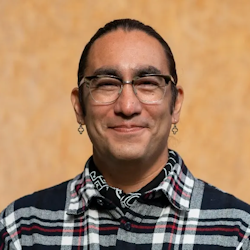 |
| Tristan Ahtone |
Tristan Ahtone: The story was originally developed at High Country News, when we worked on the investigation "Land Grab Universities." Unfortunately, HCN was not interested in pursuing it at the time, so it was put on hold until Grist took interest.
SEJournal: What was the biggest challenge in reporting the series and how did you solve that challenge?
Ahtone: A primary difficulty lay in the fragmented and inconsistent nature of the data. State trust lands are managed by individual states, each with its own system for recording, storing and sharing data. Some states provided comprehensive digital spatial datasets, while others offered incomplete, poorly formatted or even non-digitized records. The historical nature of the subject further complicated matters, as records of land cessions are incomplete and often represent the perspective of U.S. law rather than Indigenous histories or epistemologies.
What makes this effort particularly unique is that no centralized database or resource previously existed to connect state trust lands, their historical origins and their ongoing uses to fund public institutions. We had to build this dataset from scratch, combining state repositories, federal land cession records and financial data. Our methodology integrated modern GIS techniques — such as spatial joins, clipping and deduplication — with historical research, including linking parcels to federal treaty information or Indian Claims Court filings and calculating payments Indigenous nations received for their lands, adjusted for inflation.
SEJournal: What most surprised you about your findings?
Ahtone: Nothing and everything. In the "nothing" category, we understand that to build America, the U.S. government enacted a series of laws to redistribute seized Indigenous lands for everything from building homesteads and corporations to establishing a public university system.
We also knew that the legislation that transformed frontier territories into full-fledged states — known as Enabling Acts — also contained handouts of land that governments could use to pay for public institutions. Those offerings are generally called “state trust lands” and are one of the best-kept public secrets in America. Our reporting confirmed our hypothesis that America is a settler-colonial nation.
‘Nearly every bit of data
we collected led to new
discoveries, ideas,
statistics and stories.’
In the "everything" category, nearly every bit of data we collected led to new discoveries, ideas, statistics and stories. In the first story in our series, “Misplaced Trust,” we found that land-grant colleges — including the University of Arizona, New Mexico State University and Texas A&M — continue to profit from 8.3 million acres taken from Indigenous nations, generating at least $6.7 billion between 2018 and 2022 alone.
But the data revealed a lot of anomalies that warranted investigation. Digging deeper, we found that more than 2 million acres of trust lands exist within the boundaries of federal Indian reservations — despite their status as sovereign nations — and are used to support public institutions like K-12 schools. And in “Wiped Off the Map,” we found that some tribes actually pay rent to the state to use trust land within their own borders.
What surprises us most is that we can understand the big ideas around our reporting, we can pursue ambitious projects like this with confidence in what the results are likely to be. But it's the details that make the difference, and what makes us most proud of our work is that we can be attentive to those details and make decisions to pursue the "smaller" stories that are born from them. The stories that really make a difference on the ground.
SEJournal: How did you decide to tell the series and why?
Ahtone: We focused on long-form features and interactive maps. The stories themselves bear incredibly complicated histories, and we believe that audiences need to be presented with as much background as they can manage, in order to understand the breadth of the dispossession we worked to expose. The maps offer audiences additional ways to explore our story though — an "uncurated" ability to explore histories and place at their own speed and leisure.
SEJournal: Does the issue covered in your project have disproportional impact on people of low income, or people with a particular ethnic or racial background? What efforts, if any, did you make to include perspectives of people who may feel that journalists have left them out of public conversation over the years?
Ahtone: Our work is focused on Indigenous history and contemporary understandings of Indigenous lives. We are a team of Indigenous journalists, people of color, and historians and educators with expertise in Indigenous affairs. We are not trying to include our perspectives in the ongoing public conversation — we are actively working to begin a completely new conversation for us and by us.
SEJournal: What would you do differently now, if anything, in reporting or telling the series and why?
Ahtone: Be more aggressive in our desires for collaboration. The collaboration we did with High Country News, for instance, is (IMO) the best in the series. The interest in collaboration with HCN on this story should have been carried to other outlets as well. The reasons for that are many, but the regret is reasonably singular.
SEJournal: What lessons have you learned from your project?
‘Time is not a valuable
metric in journalism for
driving action or change.’
Ahtone: A lot. Here are three: Uncertainty is a strength. Time is not a valuable metric in journalism for driving action or change. Limitation can be the finest inspiration of all.
SEJournal: What practical advice would you give to other reporters pursuing similar projects, including any specific techniques or tools you used and could tell us more about?
Ahtone: Don't worry about the tools or techniques. Work with the people around you and rely on their experience and dreams. Trying something that’s risky and dangerous, and doing it together, creates the ultimate sense of solidarity.
SEJournal: Could you characterize the resources that went into producing your prize-winning reporting (estimated costs, i.e., legal, travel or other; or estimated hours spent by the team to produce)? Did you receive any grants or fellowships to support it?
Ahtone: We spent almost two years with a team of dozens relying on staff time and multiple grants. The big thing here is that these projects don't come together without a lot of people.
Tristan Ahtone is a member of the Kiowa Tribe and is editor-at-large at Grist. He previously served as editor-in-chief at the Texas Observer and Indigenous affairs editor at High Country News. He has reported for Al Jazeera America, PBS NewsHour, Indian Country Today and NPR, to name a few. A past president of the Indigenous Journalists Association, Ahtone is a 2017 Nieman Fellow.
* From the weekly news magazine SEJournal Online, Vol. 10, No. 19. Content from each new issue of SEJournal Online is available to the public via the SEJournal Online main page. Subscribe to the e-newsletter here. And see past issues of the SEJournal archived here.
SEJ Publication Types:
Topics on the Beat:
Region:
Visibility: