


SEJournal Online is the digital news magazine of the Society of Environmental Journalists. Learn more about SEJournal Online, including submission, subscription and advertising information.
September 3, 2025
 |
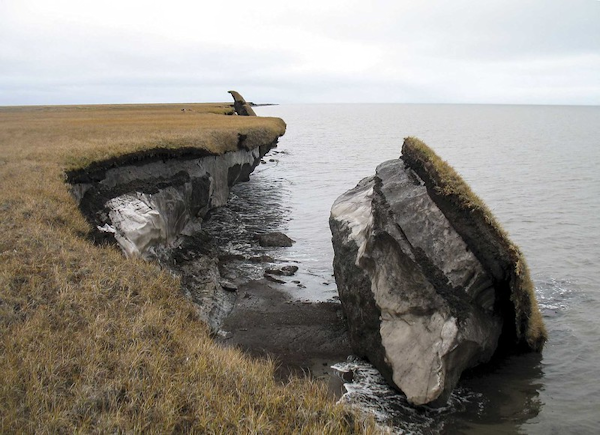 |
| Above, a collapsed block of ice-rich permafrost along Drew Point, Alaska. Meanwhile, federal science grants with the word “climate” in them have largely been canceled. Photo: U.S. Geological Survey/Benjamin Jones via Flickr Creative Commons (United States government work). |
WatchDog Opinion: Trump Climate Science Denial Hinges on … Not Saying the Word
By Joseph A. Davis
The Trump 2.0 administration has declared a broadscale war on climate science and action — on behalf of fossil energy companies that have contributed heavily to his 2024 campaign. A key prong in this offensive is an unprecedented level of science denial and censorship.
What’s old is new again. Climate denial is almost as old as climate science. Only a few of today’s environmental journalists were around when NASA scientist James Hansen told Congress in 1988 that global warming had already arrived.
Within a year, two things happened: Scientists formed the Intergovernmental Panel on Climate Change to study it. And the fossil lobby formed the Global Climate Coalition to deny the science.
The war on climate science started
well before Donald Trump. But he
does seem to be trying to win it.
So the war on climate science started well before Donald Trump. But he does seem to be trying to win it.
In April 2024, Trump promised to torch federal climate action if a group of 20 fossil CEOs gathered at Mar-a-Lago would pledge $1 billion to his campaign.
Since he took office in January 2025, Trump has been keeping his word. He’s not only canceling climate regs, but also poleaxing climate science and censoring climate information.
The words we mustn’t speak
Let’s look at the censorship part.
 |
One approach to climate denial was invented by Florida’s Republican then-Gov. Rick Scott, who decreed that state employees could not use the word climate in official correspondence.
His successor, Republican Gov. Ron DeSantis, went him one better in 2024 when he got the legislature to remove the words climate change from most state laws.
That’s magical thinking: If we don’t say the word, it won’t exist. Denial ain’t just a river in Egypt.
Yet that seems to be the approach that Trump 2.0 is taking at the U.S. Environmental Protection Agency and throughout the government. Not just denying the science — but forbidding the word. It’s like Orwell’s memory hole.
It’s like what second graders do when they don't like what another kid is saying: stick their fingers in their ears and make noise. Expensive lawyers do it, too.
Systematic attacks on climate policies
Let’s settle a couple of things.
One: Despite any doubts three-and-a-half decades ago, some 97% of scientists currently are convinced that humans are changing the climate.
Two: Science discovers truths by testing hypotheses with an open mind. Uncertainty does not invalidate science; it is a key part of the scientific method.
The fossil industries have been trying to discredit climate science all that time, but they have developed more subtle, sophisticated and secretive ways to do it. That’s partly because few people believe them anymore.
At least a solid majority of people
in the United States are convinced that
human-made climate change is real.
At least a solid majority of people in the United States are convinced that human-made climate change is real.
Here’s a partial list of things Trump 2.0 has done since taking office.
- The administration has worked systematically to force “straight up deletion” of climate mentions in public information and websites, according to the data rescuers at the Environmental Data & Governance Initiative. The word “resilience” is banned, too.
- Every four years or so, a huge team of experts in and out of government has published the National Climate Assessment, a compendium of research about climate impacts on the United States. It is required to be published by the Global Change Research Act of 1990. The George W. Bush administration tried to unpublish a previous edition (unsuccessfully). Trump killed the current edition and dismissed scores of authors. Then he disappeared previous editions from government websites and killed the contract for producing it. Find the banned reports here. Dismissed authors are going ahead anyway.
- During his confirmation hearing, Trump Energy Secretary (and former fracking exec) Chris Wright said the current wave of severe wildfires had nothing to do with climate change.
- The incoming Trump Agriculture Department took down information on climate-smart farming this year; environmental groups took them to court.
- Right after the inauguration, Trump took down the Climate and Economic Justice Screening Tool, which had been used to allocate aid to disadvantaged communities. Environmentalists cloned it and put it back up.
- In response to growing climate disasters, the Federal Emergency Management Agency had developed an online mapping tool to show the relative risk from climate disasters from place to place across the United States. Trump 2.0 deleted it from the web. The Guardian recreated and republished it.
- The EPA has historically published its greenhouse gas inventory every year. This year it didn’t (see related TipSheet). The inventory is supposed to be submitted by each nation under the 2015 Paris Agreement (which Trump then pulled the United States out of). The Environmental Defense Fund successfully FOIA’d it and published it anyway.
There’s lots more. Amid all the carnage of canceled federal science grants (by agencies like the National Science Foundation), any with the word “climate” in them have been shredded. A few climate researchers have survived by deleting the word.
Not saying the C-word won’t help fossil firms keep making money (although they seem to be making plenty anyway).
Climate change will happen whether we say the word or not. Journalists will still have to cover heat waves, floods, droughts, hurricanes, wetland loss, wildfires, deforestation, desertification, famine, extinction and the politics thereof. With fact-checking.
[Editor’s Note: For more, visit the Topics on the Beat: Climate Change page, which includes a variety of SEJournal stories and recent EJToday headlines.]
Joseph A. Davis is a freelance writer/editor in Washington, D.C. who has been writing about the environment since 1976. He writes SEJournal Online's TipSheet, Reporter's Toolbox and Issue Backgrounder, and curates SEJ's weekday news headlines service EJToday and @EJTodayNews. Davis also directs SEJ's Freedom of Information Project and writes the WatchDog opinion column.
* From the weekly news magazine SEJournal Online, Vol. 10, No. 30. Content from each new issue of SEJournal Online is available to the public via the SEJournal Online main page. Subscribe to the e-newsletter here. And see past issues of the SEJournal archived here.
SEJ Publication Types:
Topics on the Beat:
Region:
Visibility: