






SEJournal Online is the digital news magazine of the Society of Environmental Journalists. Learn more about SEJournal Online, including submission, subscription and advertising information.
November 11, 2026
 |
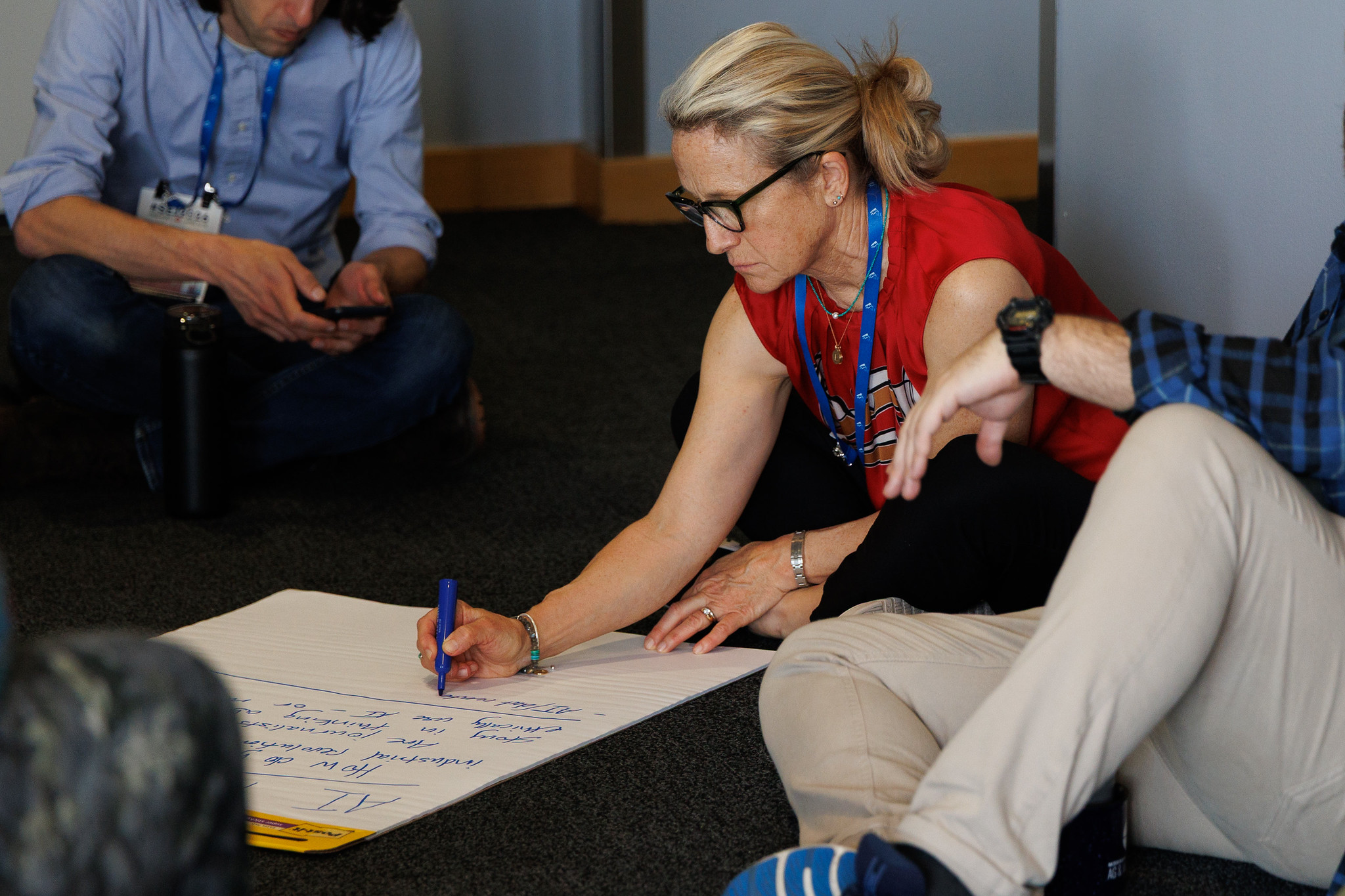 |
| Colorado-based independent journalist Jennifer Oldham takes notes during an SEJ conference workshop discussion of climate, AI and data centers. Photo: SEJ/IsabelPerkinson via Flickr Creative Commons (CC BY-NC-ND 4.0). |
Feature: Mapping the Future of Climate Journalism
By Angela K. Evans and Andrew McCormick
Climate journalists are asking a lot of soul-searching questions these days.
What role should we play, at a time when so many in power are turning their backs on the climate challenge?
As the federal government guts clean energy programs and attacks at the mere mention of climate change, what is our responsibility to the public to continue sounding the alarm and highlighting solutions that work?
And should journalists follow suit as so-called “climate hushing” — a belief that we should all say less about climate change, due either to the perception (or misapprehension) that people are sick of hearing about it or to worries that it risks further government antagonism — grips the business world and even corners of the environmental movement?
Five years ago, our profession was replete with examples of newsrooms supercharging their climate coverage, including by hiring more reporters and standing up new climate desks and verticals.
Today, we see layoffs upon layoffs,
with even former climate stalwarts
scaling back or outright
eliminating their climate teams.
Today, by contrast, we see layoffs upon layoffs, with even former climate stalwarts — the likes of CBS News, NPR and The Washington Post — scaling back or outright eliminating their climate teams; in 2025, climate coverage by U.S. broadcast networks fell by 35%, according to a study by Media Matters for America.
If newsroom leaders are giving up on the climate story, where will dedicated climate journalists who remain on the beat find the editorial support and resources to continue the work?
These challenging questions formed the backdrop of a workshop we led last spring at the 2026 Society of Environmental Journalists’ conference in Chicago. And an unexpectedly large group showed up to tackle them.
Harnessing collective wisdom
A week or so before the conference, one of us — we don’t remember which — messaged the other: “Is anybody even going to come to this workshop?”
Representing Solutions Journalism Network and Covering Climate Now, we were scheduled to lead a session called “Mapping the Future of Climate Journalism.”
The subject was as urgent and relevant as ever, but we had good reasons to worry about turnout. After all, our workshop was set for the day before the conference would officially commence. And a fee, nominal but nonetheless, was required to attend.
Nor were we hosting a traditional conference workshop, with heralded speakers and experts to draw a crowd. Instead, it would be a participant-driven event, meant to harness the collective wisdom of the group. We’d never hosted something like this at SEJ, though, and weren’t sure it would resonate.
And so, imagine our surprise when we wound up with a packed room. Not only was every seat taken but journalists — who represented a wide variety of backgrounds and many corners of the industry — had brought in extra chairs and squeezed together at tables. Still more people crowded standing in the back, with some even taking a seat on the floor.
Making this all the more remarkable, the room was sweltering. In mid-April, the conference host, the University of Illinois Chicago, had not yet activated its buildings’ air-conditioning systems; record-breaking temperatures in the city that day meant everyone was sweating. Many fanned themselves with notebooks.
Never mind the heat, we had work to do.
A new blueprint
Our goal was to set an agenda for the climate journalism community. That is, what are the conversations we need to have and the questions we need to answer to collectively find our way through this difficult moment?
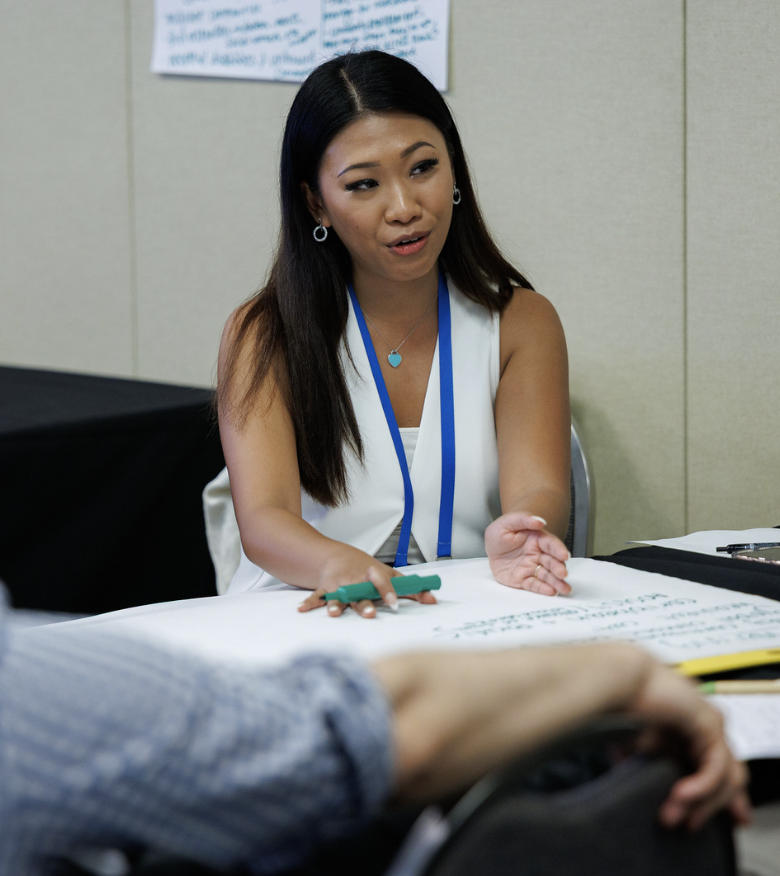 |
| Rachel Ramirez in a workshop discussion about covering small island nations and climate change. Photo: SEJ/IsabelPerkinson via Flickr Creative Commons (CC BY-NC-ND 4.0) |
It’s an ambitious and complicated question, to be sure, but not a new one for our organizations. In 2023, SJN and CCNow hosted climate journalists around the world at a conference in New York; the result of that meeting was the expansive “Climate Blueprint for Media Transformation,” published in 2024. We viewed this SEJ workshop as an opportunity to pick up where the blueprint had left off.
To get started, workshop participants identified 12 topics for exploration — among them, how to grapple with artificial intelligence, how to identify and seize fundraising opportunities, how to better represent Indigenous perspectives in our storytelling, and the critical but challenging work of freelancers in the climate journalism space.
After more than three hours of small-group discussions, one thing was clear: Environmental journalists want to be together, talking about their work, their experiences and the challenges they face on this beat.
Many participants told us they were thrilled simply to be in community with one another — to be among like-minded, passionate colleagues at a moment when climate journalists report feeling isolated in our seemingly endangered profession.
Indeed, this enthusiasm echoed what SJN and CCNow routinely hear from our (frequently overlapping) communities: that opportunities to come together are a needed source of strength, on an all too often grim beat. This ethos undergirds much of SJN’s and CCNow’s work: Climate journalists are strongest when we seek out community and work together.
Below, we share a few key takeaways from select working groups.
AI and data centers in climate reporting
This working group agreed that there are many gray areas, information gaps and uncertainty about how AI will evolve, for both journalism and the communities we cover.
The main question they sought to address was: Given AI’s massive and ever-growing climate footprint, how should climate journalists help inform its use, both in our newsrooms and our communities?
For newsrooms, they discussed the need for templates and examples of AI policies, and transparency disclosures about how it’s used.
Within communities, there’s both support and opposition when it comes to data centers, and our reporting needs to reflect the nuanced costs and benefits of AI.
The group agreed that journalists could gain from more resources around covering data centers and how to use AI ethically in our journalism.
To build AI and data center literacy, the group pointed to coverage by the Chicago Tribune and the Toledo Blade, as well as Earth Journalism Network’s “Dark Side of the Boom.” Participants also referenced Halt the Harm for a compendium of data center resources that could be useful to reporters.
Indigenous narratives and storytelling
This conversation started with the acknowledgment that climate stories need to involve Indigenous voices, because Indigenous communities, cultures and practices are highly impacted by the changing environment — but can also inform solutions.
Climate reporters should gain a basic understanding of the United Nations Declaration of the Rights of Indigenous Peoples and tribal consultation laws that recognize the sovereignty of tribal nations. Journalists should refer to Duncan McCue’s book “Decolonizing Journalism,” the Indigenous Journalists Association’s famed Bingo Card tool, which calls out common tropes and stereotypes in mainstream news coverage, and other IJA resources.
For the environment beat specifically, Media Indigena’s podcast Beyond Fires and Floods offers in-depth conversations on Indigenous climate narratives.
The group further discussed how to
effectively engage and build trust
with Indigenous people to ensure
that reporting isn’t extractive.
The group further discussed how to effectively engage and build trust with Indigenous people to ensure that reporting isn’t extractive. Best practices include: reporting with humility and patience, interrogating our biases and assumptions, taking the time to inform ourselves of tribal government structures and press freedom laws, and being transparent about our reporting process and intentions with Indigenous sources.
Journalists pointed to Grist as an example of excellent Indigenous coverage, specifically Anita Hofschneider and Jake Bittle’s story “How the Klamath Dams Came Down.”
Collaborating with content creators to reach a wider audience
As it is across our industry, participants in this conversation were curious about the content creation space, partnering with social media influencers and how to meet the demand to do more and more online.
They also brought their natural skepticism to talk through ethical concerns, how to maintain journalistic standards in content creation and how to synthesize nuanced climate reporting into the length of a reel.
This group talked about the great opportunity in journalistic content creation, being that it meets audiences where they are — since most people these days get their news on social media — and democratizes information.
More newsrooms and journalists are moving into the creator space, such as the Los Angeles Times and Mother Jones, which both employ content creators. Specifically in the climate space, influencers like Climate Diva help tell the climate story.
Yet, the group acknowledged that there are real tensions to consider.
Content creation doesn’t necessarily subscribe to the same ethical code as journalism and often doesn’t have a process for vetting and editorial review. Questions remain about authorship and attribution, equity in compensation and labor, and differentiating content creators from influencers.
Where do we go from here?
In the coming months, SJN and CCNow will continue to offer opportunities to connect virtually.
You can join SJN’s Climate Peer Network and CCNow’s ever-growing Slack workspace to connect with others in the field.
Also keep an eye out for webinars that will take up and continue conversations that our workshop participants started in Chicago. And we may even collaborate again on an in-person gathering.
But please don’t wait for us. This community is all of ours.
[Editor’s Note: Material for this story was drawn from a workshop moderated by Evans and McCormick at the Society of Environmental Journalists’ annual conference in Chicago in April 2026, whose sponsors are listed here.]
Angela K. Evans is the director, communities of practice at the Solutions Journalism Network, where she supports, develops and connects like-minded journalists, creating more opportunities for peer learning. She also leads SJN’s global network of climate journalists and other programs designed to empower reporters to tell solutions-focused stories about the environment. Based in Denver, Colorado, she’s been a local reporter and editor since 2014, with an emphasis on immigration, local policy, energy and climate.
Andrew McCormick helped launch Covering Climate Now in 2019 and serves as the organization's deputy director. His writing and reporting have appeared in The New York Times, The Atlantic, The Guardian, The Nation and Columbia Journalism Review, where he was a Delacorte Magazine Fellow, among other outlets. McCormick has additionally been adjunct faculty at Columbia University’s Graduate School of Journalism and is a U.S. Navy veteran.
* From the weekly news magazine SEJournal Online, Vol. 11, No. 40. Content from each new issue of SEJournal Online is available to the public via the SEJournal Online main page. Subscribe to the e-newsletter here. And see past issues of the SEJournal archived here.
SEJ Publication Types:
Topics on the Beat:
Visibility: