


SEJournal Online is the digital news magazine of the Society of Environmental Journalists. Learn more about SEJournal Online, including submission, subscription and advertising information.
October 29, 2025
 |
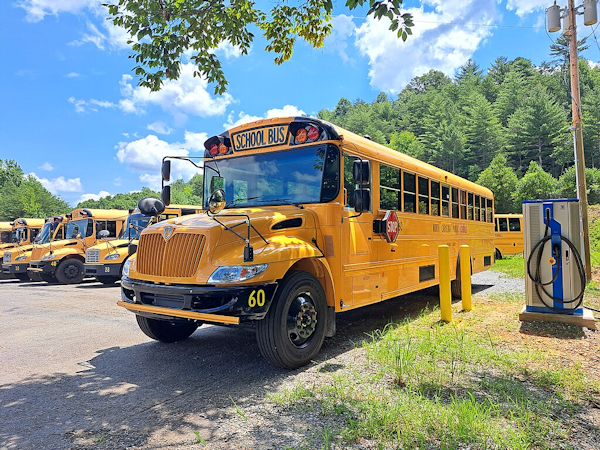 |
| A $5 billion plan to bring clean buses to the nation’s schools is in jeopardy. Above, the first electric school bus for North Carolina’s Cherokee County Schools. Photo: JoshuaB-Jimenez via Wikimedia Commons (CC BY-SA 4.0). |
TipSheet: Will Your Town Pass the Electric School Bus Acid Test?
By Joseph A. Davis
 |
Getting kids to school is hard enough. But can the school district in your reporting area get them there on an electric school bus?
A lot of parents, teachers and administrators were happy to hear the news in 2021 that when then-President Joe Biden signed the massive “Bipartisan Infrastructure Law,” some of the federal money in that $1.2 trillion megabill was set aside to help schools buy electric school buses. In total, $5 billion worth over the fiscal years 2022 to 2026.
But will Trump 2.0 defund (requires subscription) their hopes for this next-gen transport?
Why it matters
Many parents stand on the curb mornings while their balky kids trundle slowly onto those orange-colored conveyances. And many get to breathe the exhaust fumes while engines idle. The fumes are unpleasant and, ultimately, potentially toxic.
Kids who ride to and from every day get even more exposure. Protecting their health is the first and most important reason why it matters. Electric buses spew no fumes.
Another good reason is climate change. Electric buses emit no greenhouse gases.
Turns out electric buses take advantage
of another quirk of EVs. The buses all
stand idle overnight in a few locations —
an ideal setup for mass charging setups.
Turns out electric buses take advantage of another quirk of EVs. The buses all stand idle overnight in a few locations — an ideal setup for mass charging setups.
Meanwhile, buses do wear out and must eventually be replaced: a good time to convert.
Story ideas
- Who manages the school bus fleets in your district or audience area? Talk to them and ask what plans or hopes they have of going electric. Do they have enough money? Where from? How long will it take?
- Ask the school district whether it has been granted any money for electric buses. Has the money arrived? All of it? Has any been held back?
- At particular times in the morning and afternoon, kids and parents can be found waiting at bus stops. The schools can tell you the routes. Go early and talk to the families about their experience with the buses — whether gas or electric.
- Go to the schools in the afternoon when kids are waiting for buses. Take a deep, investigative breath. Do the buses idle? Are they polluting?
- Talk to school district officials (e.g., principals, administrators) about their problems and needs related to busing.
- School buses often park overnight at a maintenance yard, where they get mechanical support. Go there at a less busy time to talk to the mechanics and schedulers about their problems and experiences.
Reporting resources
- Electric School Bus Initiative: A project of the nonpartisan, nonprofit World Resources Institute, the initiative advocates for the conversion of the current diesel bus fleet to electric. It operates the useful Electric School Bus Data Dashboard, which tries to track the progress of fleet conversion.
- Alliance for Electric School Buses: Another nonprofit that advocates for electric school buses.
- U.S. Environmental Protection Agency: Theoretically, the EPA’s Clean School Bus Program is supposed to distribute the federal funds for electric buses. Under Trump 2.0, most of their webpage is marked “closed.”
- IC Bus: This commercial firm sells and promotes electric buses. It is nonetheless a good source of information.
- National School Transportation Association: This trade group represents the private contractors who operate school bus fleets. It is somewhat neutral on fleet conversion.
[Editor’s Note: For more on electric vehicles, see our special Backgrounder on EVs for the “2024 Journalists’ Guide to Environment and Energy,” as well as a Backgrounder on EV charging stations and a TipSheet on “Burgeoning National EV Trend Helps Drive Local Environment, Climate Stories.” We have additional Backgrounders including “Carmakers Map Out Shifting Road Ahead” and “Does Climate’s Future Depend on Better Batteries?” and a Feature, “Is EV-Driven Demand for Lithium on Collision Course With Environment Concerns?” Plus, get up-to-date EV headlines from EJToday.]
Joseph A. Davis is a freelance writer/editor in Washington, D.C. who has been writing about the environment since 1976. He writes SEJournal Online's TipSheet, Reporter's Toolbox and Issue Backgrounder, and curates SEJ's weekday news headlines service EJToday and @EJTodayNews. Davis also directs SEJ's Freedom of Information Project and writes the WatchDog opinion column.
* From the weekly news magazine SEJournal Online, Vol. 10, No. 38. Content from each new issue of SEJournal Online is available to the public via the SEJournal Online main page. Subscribe to the e-newsletter here. And see past issues of the SEJournal archived here.
SEJ Publication Types:
Topics on the Beat:
Region:
Visibility: