

SEJournal Online is the digital news magazine of the Society of Environmental Journalists. Learn more about SEJournal Online, including submission, subscription and advertising information.
June 17, 2026
 |
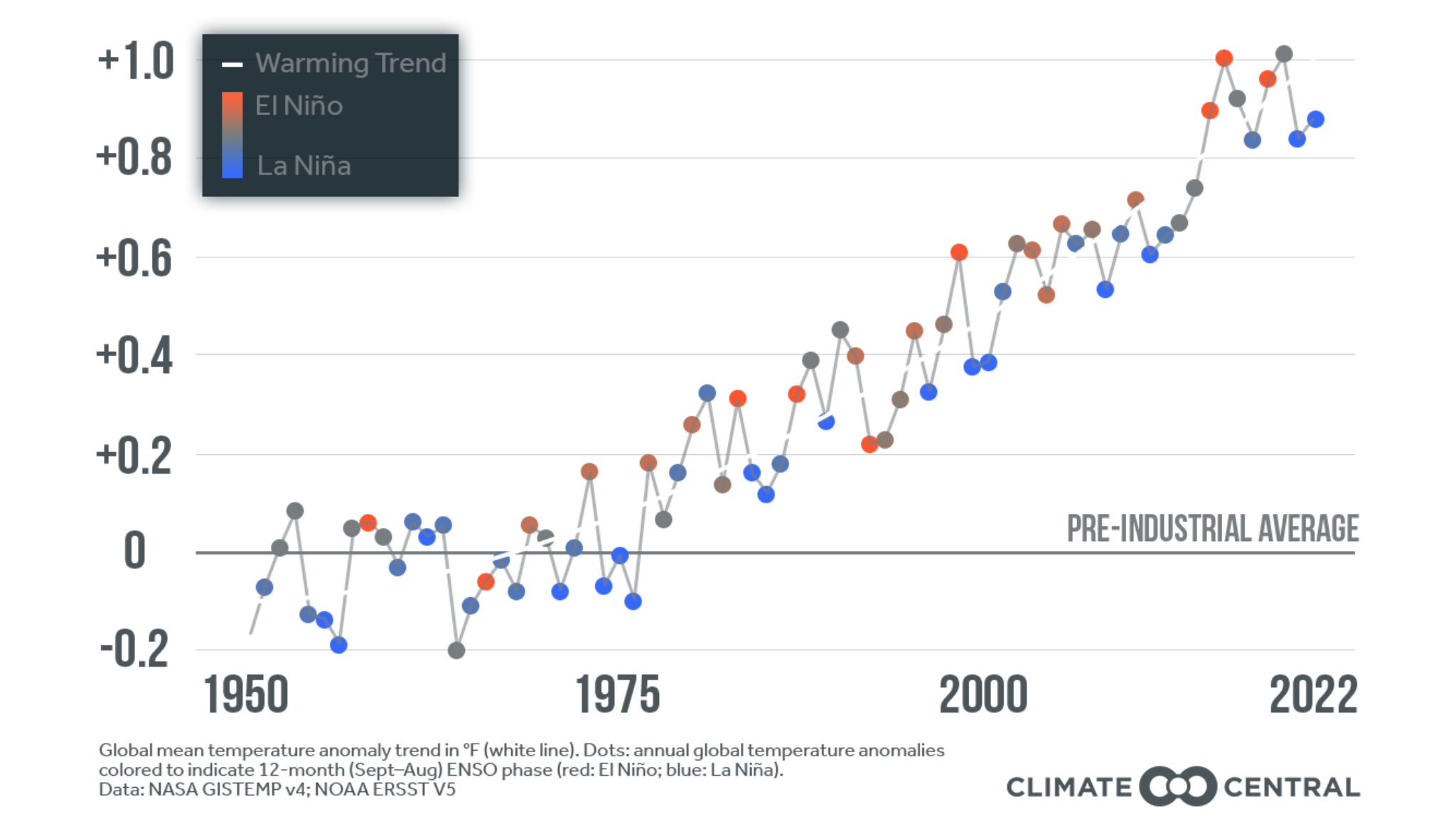 |
| A chart showing global temperature rise boosted in El Niño years. Image: Climate Central (CC BY 4.0). |
Backgrounder: A Super (Probably ‘Duper’) El Niño Is Coming. Watch Out!
By Joseph A. Davis
This year will be different. It will be hotter, cooler, wetter and drier in ways and places that few living have experienced. A huge El Niño is coming.
You’ve heard the term — but what does it really mean? At its simplest, it’s a multiyear weather pattern. It is an oscillation (a “swing”) in the temperature of the surface water of the equatorial Pacific Ocean. But since the Pacific is global in scale, it produces changes in weather over most of the Earth.
How did it get that name? Since it often arrives around Christmastime, Peruvian fishers got in the habit of calling it “the little boy,” i.e., the Christ child in Spanish. When it swings back the other way, it is called La Niña, the little girl. Scientists call it ENSO, for El Niño-Southern Oscillation.
It’s cyclical — but the time it takes
to complete the cycle varies a lot
in ways that seem almost random.
It goes, as they say, both ways. El Niño is hotter water temperatures in the equatorial Pacific and La Niña is colder water. It’s cyclical — but the time it takes to complete the cycle varies a lot in ways that seem almost random, typically three to seven years.
But in the last few decades, temperature instruments and computers have gotten better, and now they can predict the cycle months (sometimes even years) ahead.
Predict? You have to realize that when meteorologists and their models “predict” something, they state it as a probability. For example: “There is a 60 percent chance of afternoon showers.” You can bet on it with Kalshi. But take your umbrella.
Why you should care
Those Chilean fishers care. Their livelihood depends on how many fish they land. They depend on the cold water upwelling from Chile’s offshore ocean depths — which contain the nutrients fish need. No upwelling, no fish. El Niño harms their livelihood.
El Niño is a global phenomenon; its impacts are global, too. During an El Niño, for example, you can expect (probabilistically) that the northern United States and Canada will be drier and warmer than usual. Southern states will tend to be wetter (beware flooding) and cooler.
If you are a U.S. farmer, it matters a lot as to what you plant and when. If you sell heating oil, it matters hugely how cold the winter is. If you run a ski resort in Western Canada, El Niño could lower the chances of good snow.
If you run a dam for hydropower or water supply in the Pacific Northwest, less snowpack is a bad thing, because you need the water. It matters for salmon runs as well, although the salmon themselves are inscrutable.
They (the scientists) say ENSO affects the hurricane season as well. This can be life-changing if you live in the wrong place. El Niño typically means a milder hurricane season; La Niña a stronger one.
How ENSO works
As the sun heats our planet, the heat is distributed via the atmosphere and ocean — with the laws of physics trying to even out its distribution.
For example, the trade winds. The sun heats the Earth most intensely at the equator, and the trade winds, which blow east to west, help to distribute it, aided by the “Coriolis effect” of the Earth’s rotation.
Other wind currents and ocean currents further distribute the heat. An example is the Gulf Stream, which moves warm water (and warmth) from the simmering Gulf of Mexico to the otherwise chilly North Atlantic. This is why Great Britain is warm enough to be comfortable. Still. Cross your fingers and hope it stays that way.
ENSO is part of the larger and
more complex web of currents
redistributing equatorial heat —
both atmospheric and oceanic currents.
ENSO is part of the larger and more complex web of currents redistributing equatorial heat — both atmospheric and oceanic currents.
During an El Niño, a band of warmer-than-usual near-surface water sets up over a huge stretch of the equatorial Pacific surface, from Indonesia to Chile. But eventually that heat is redistributed globally.
One thing that’s different about ENSO is its timescale. While weather changes in a matter of days and climate (which has its own cycles) changes naturally over centuries or millenia, ENSO changes must be envisioned on a scale of a few years. And using a quite different set of computer models.
When the flow of a fluid (atmospheric air or oceanic water) changes from smooth to turbulent, the physics governing its movement change as well. That means different equations — with turbulent (ENSO) flows being more random than the more predictable ocean currents. Faster computers allow bigger models to calculate these more nearly random movements.
And satellites got better. Decades ago, scientists relied on a fleet of mid-Pacific buoys to carry their instruments, recording things like current and water temperature. The array was called TAO, for Tropical Atmosphere Ocean.
Today, the TAO array is being overhauled and thoroughly upgraded. But satellite instruments have also improved. Not only can they sense more minute changes in water temperature, they can measure quite precisely any changes in the height (altitude) of the sea surface itself.
The discovery: Sea surface height changes with ENSO, too.
The scientists studying ENSO have their own home: a unit of the National Oceanic and Atmospheric Administration called the Climate Prediction Center. This unit focuses on mid-scale meteorological changes: neither the hour-to-hour weather nor the decades-to-centuries of global warming. But weeks to years.
At least until the Trump administration closes its doors.
Now the ‘bad news’
Today, many headlines are blazing warnings of a “super” El Niño. See the above caveats about predictions. Headlines being headlines, some of them tend to shout. Reality in the end will tell.
The Washington Post, bless its heart, warns readers of “one of the strongest El Niño events on record” and conjures visions of the 1877 El Niño as “the worst environmental disaster in human history.”
The strong El Niño of that year “fueled conditions that led to a global famine which killed more than 50 million people across India, China, Brazil and elsewhere,” the Post declares.
It may or may not be excessive overhyping. The Post is not the only one.
Weather/climate and food security are
profoundly linked, and have been
throughout human history.
Perhaps it is doing us all a service by reminding us that weather/climate and food security are profoundly linked, and have been throughout human history and prehistory. Climate warming has every possibility of causing mass starvation. So does human indifference and greed.
But the NOAA CPC page describing what they see ahead couldn’t be duller. It’s written in science-speak and numbers. And that may be a disservice to the public as well.
[Editor’s Note: For more on this topic, see a recent Feature on how attribution science can help reporters on the heat beat, as well as an earlier Feature on how climate attribution science went mainstream, and what it means, plus our Topic on the Beat pages on climate change and disasters, including dozens of SEJournal stories, special reports and other resources, and related headlines from EJToday.]
Joseph A. Davis is a freelance writer/editor in Washington, D.C. who has been writing about the environment since 1976. He writes SEJournal Online's TipSheet, Reporter's Toolbox and Issue Backgrounder, and curates SEJ's weekday news headlines service EJToday and @EJTodayNews. Davis also directs SEJ's Freedom of Information Project and writes the WatchDog opinion column.
* From the weekly news magazine SEJournal Online, Vol. 11, No. 24. Content from each new issue of SEJournal Online is available to the public via the SEJournal Online main page. Subscribe to the e-newsletter here. And see past issues of the SEJournal archived here.
SEJ Publication Types:
Topics on the Beat:
Region:
Visibility: