



SEJournal Online is the digital news magazine of the Society of Environmental Journalists. Learn more about SEJournal Online, including submission, subscription and advertising information.
August 5, 2026
 |
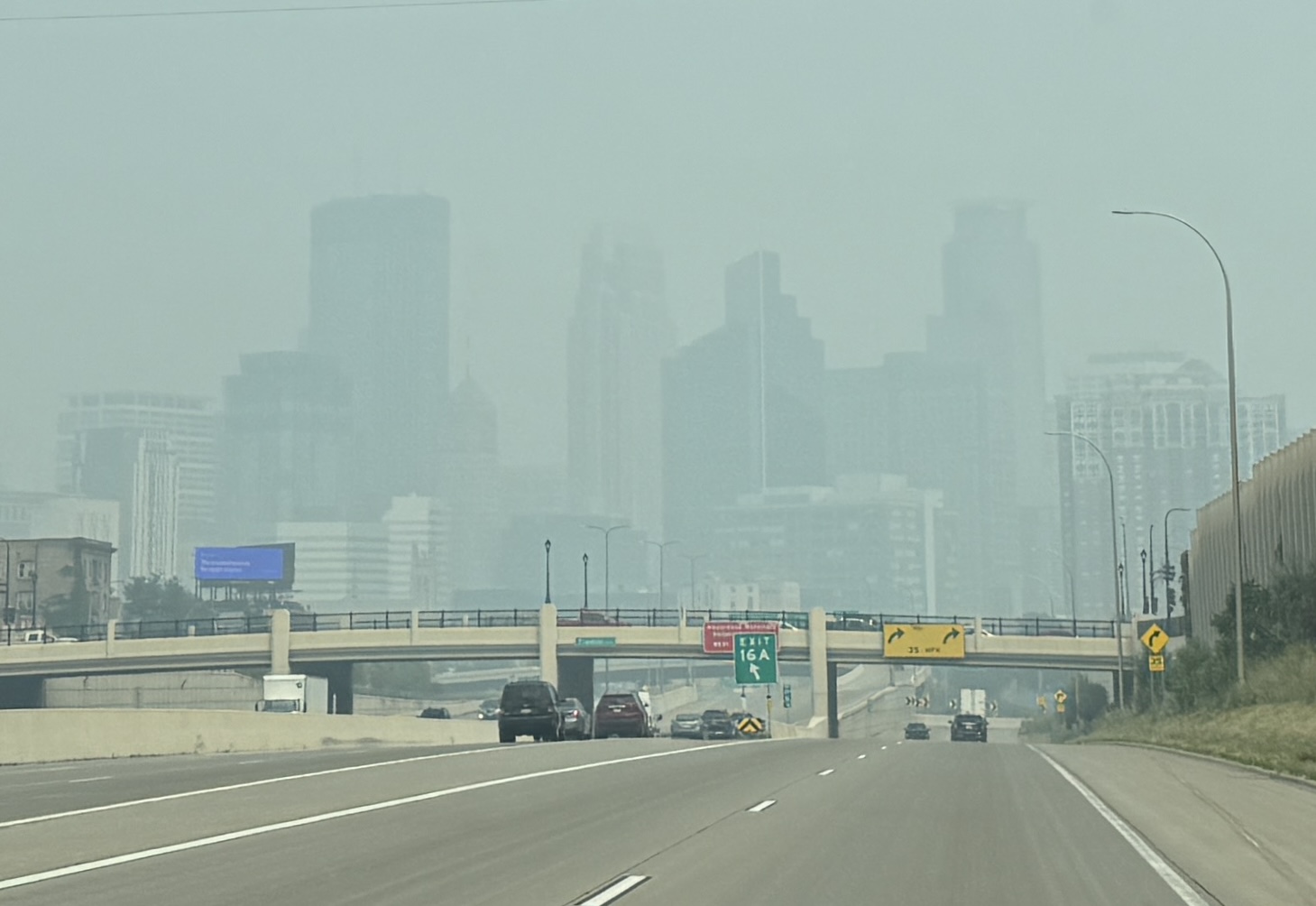 |
| Wildfire smoke blankets downtown Minneapolis on July 16, 2026, prompting the Minnesota Pollution Control Agency to issue an air quality alert. Photo: Jill/Blue Moonbeam Studio via Flickr Creative Commons (CC BY-NC-ND 4.0). |
TipSheet: Extremely Hot Weather Cooks Up Unusually Awful Air Pollution
By Joseph A. Davis
Ah, summer: heat, humidity … and smog. The air we breathe turns a hazy grey or a murky brown. We’re lucky when it’s not orange. Chemistry kills.
There is a catalog of air-pollution awfulness in the summer. And environmental journalists do need to know a bit about atmospheric chemistry.
It matters because in the summer, many of the people who arrive in emergency rooms are suffering from heat-related maladies. These can include heart attacks, heat stroke, asthma, jellyfish stings, skin rashes, insect bites and waterborne illness up to and including cholera.
Now, add in the effects of smog.
The backstory
In the old days — before the Clean Air Act of 1970 — urban smog in places like Los Angeles had gotten so bad that it was the poster child for pollution. Since then, atmospheric chemists have learned a huge amount about how air pollution works.
U.S. city air is clearer now.
So is smog science.
But it’s still complicated.
Not only is U.S. city air clearer now. So is smog science. But it’s still complicated.
Summer smog is formed when humans emit nitrogen oxides into the air, from various sources, but especially petroleum-powered cars and trucks.
Other pollution sources (including not only vehicles, but also power plants, refineries and other industrial operations) emit volatile organic compounds, or VOCs, into the air. One example of a VOC is formaldehyde; another is paint stripper. And let’s not forget raw gasoline.
Once those precursor pollutants are in the summer air, the high temperatures and sunlight go to work, literally cooking them and producing chemical reactions — the most important product of which is ozone.
Ozone makes people’s eyes sting, damages their lungs and airways, and threatens their respiratory health.
Summer smog is usually a much more complex gumbo of precursor pollutants, photochemical ozone and many other yucky pollutants that come along with them — especially soot (fine particulate matter smaller than 2.5 microns).
Nowadays, widely dispersed
wildfire smoke is often a given
that just makes things worse.
Nowadays, widely dispersed wildfire smoke is often a given that just makes things worse. Extremely hot fires send smoke high into the atmosphere, where it may travel hundreds of miles and end up as murk far from the source, sometimes sparking inflammatory political discourse.
It is easy to get confused about ozone. The gas that is harmful at the ground level, where we breathe, is beneficial up higher in the stratosphere, where it shields us from harmful ultraviolet radiation. Stratospheric ozone helps humans; ground-level ozone hurts us.
Smog is often somewhat different in the winter than it is in the summer. Typically, the winter version contains large proportions of particulates — from home heating by wood, coal, oil or other dirty fuels — as well as dirtier vehicle emissions from drivers warming up cold engines. All of these become more harmful when winter air forms atmospheric inversions over urban areas, trapping the pollutants near concentrations of people.
Story ideas
- Is smog a problem in your area? Is it winter smog or summer smog (or both)? Ask state and local health departments.
- What are the underlying sources of smog and its precursors in your airshed? Beyond vehicles, of course. What has been done to control them? Can your state or locality do more? How?
- Does your audience live in a Clean Air Act “nonattainment area”? Check the federal Green Book lists. Is smog (ozone) one of the problems? What, if anything, has your area done to improve air quality?
- Go to local auto dealer showrooms and talk to shoppers, salespeople and management about the choice between gas and electric cars.
- Are there enough public fast-charging stations in your area? Check parking lots, shopping malls, etc.
- What powers the school buses that deliver kids to your area schools? Is there talk of electrifying them? Is there funding?
- Are any new or expanded highways planned for your area? What will be the pollution effects?
Reporting resources
- U.S. Environmental Protection Agency: The EPA is supposed to enforce the Clean Air Act. During some administrations, they actually do. It oversees state and local efforts to fight smog.
- National Association of Clean Air Agencies: The NACAA includes leaders of the state air quality agencies that actually implement and enforce the Clean Air Act. See also the Association of Air Pollution Control Agencies, a rump alliance consisting mostly of Southern and Western states.
- American Lung Association: This nonprofit NGO advocates for lung health and against things (like smog) that threaten it.
- AirNow: This multi-agency project measures, maps and predicts air pollution in close-to-real time, including wildfire smoke. Online maps let you know your local smog levels. It also provides air quality data for Canada and Mexico.
- Natural Resources Defense Council: The NRDC is a large membership group that focuses on litigation and scientific information.
- Moms Clean Air Force: A network of organizers that includes parents trying to protect vulnerable kids from health threats like smog.
- Clean Air Task Force: This membership-based nonprofit NGO is one of the original anti-smog groups.
- Alliance for Automotive Innovation: The main carmakers’ lobby. Reborn from the ashes of the Automobile Manufacturers Association, this is the classic pro-industry advocacy group.
[Editor’s Note: For more on air pollution and smog, see TipSheets on the health threats and geographic reach of wildfire smoke, Reporter’s Toolboxes on air pollution data sources, air quality monitors and asthma data, a Backgrounder on wildfire smoke and a Feature about investigative reporting on wildfire pollution-reporting rules. Plus track the latest smog headlines via EJToday.]
Joseph A. Davis is a freelance writer/editor in Washington, D.C. who has been writing about the environment since 1976. He writes SEJournal Online's TipSheet, Reporter's Toolbox and Issue Backgrounder, and curates SEJ's weekday news headlines service EJToday and @EJTodayNews. Davis also directs SEJ's Freedom of Information Project and writes the WatchDog opinion column.
* From the weekly news magazine SEJournal Online, Vol. 11, No. 28. Content from each new issue of SEJournal Online is available to the public via the SEJournal Online main page. Subscribe to the e-newsletter here. And see past issues of the SEJournal archived here.
SEJ Publication Types:
Topics on the Beat:
Region:
Visibility: