

SEJournal Online is the digital news magazine of the Society of Environmental Journalists. Learn more about SEJournal Online, including submission, subscription and advertising information.
December 10, 2025
 |
| “Sacred Planet,” a documentary series exploring how climate change is reshaping sacred spaces, led its creator, Gulnaz Khan, to learn a new visual storytelling language. Click the image to watch a preview. Image: PBS/”Sacred Planet with Gulnaz Khan.” |
EJ InSight: From Words to Frames — Writer Learns To Wield Power of Visual Storytelling
By Gulnaz Khan
Several years ago, I came across a series of old black-and-white photographs from the Himalayas — pilgrims winding through snow and stone toward a cave where an ice stalagmite, believed to be a manifestation of Shiva, rises each year. The frames were grainy, austere, magnetic. I was drawn in before I’d read a single caption.
I later learned that this sacred ice is vanishing, melting away as the planet warms. For the pilgrims, it isn’t just a natural loss — it’s a spiritual rupture, a sign that the divine is withdrawing its presence from a world out of balance. Those photographs became something different then: a record of devotion and disappearance.
That realization became the spark for “Sacred Planet with Gulnaz Khan,” a PBS documentary series exploring sacred sites under threat from climate change around the world. As a writer, it also altered how I think about storytelling itself: Some stories can’t live fully in words. They have to be seen, heard and felt.
Here are five things I learned on my journey from text to screen:
1. Collaborate with visual thinkers as intellectual partners
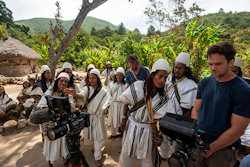 |
| Arhuaco community members view footage alongside the camera crew during filming of "The Heart of the World" episode near Nabusimake, Sierra Nevada de Santa Marta, Colombia. Photo: Jorge Arango. |
Writers sometimes think of cinematographers, photographers and editors as technical support rather than creative collaborators — a massive missed opportunity. Visual specialists understand how light, movement, composition and rhythm create meaning in ways that can complement and sometimes surpass written narrative.
The most effective collaborations begin early, in story development rather than execution. In our series, this meant bringing the director into script development to map scenes visually, while I developed them narratively, ensuring story and image evolved together rather than sequentially.
On location, that trust extended to the entire crew. Our aerial photography lead in South America, for example, would frequently flag powerful compositions and chase those intuitions in real time, creating some of our richest scenes that weren’t on the official shot list.
Share your narrative intentions, not just your shot list. Instead of saying, “I need a shot of melting ice,” say, “I need to convey how environmental disruption feels spiritually devastating.” That framing invites creative problem-solving instead of technical compliance.
Develop a shared vocabulary. Learn the basics of visual grammar — composition, color theory, pacing — while helping your collaborators understand narrative structure and theme. The best visual stories emerge from true partnership between verbal and visual thinkers, where each strengthens the other’s instincts.
2. The limits of doom-and-gloom in environmental storytelling
In environmental storytelling, it’s tempting to rely on bleak imagery and apocalyptic tone. But research shows that this can backfire: Catastrophe fatigue often leads to despair and disengagement. The most resonant stories balance urgency with agency — showing not only what’s at stake, but also how people respond, adapt and build resilience.
While developing “Sacred Planet,” we built this balance into every episode. We showed the degradation of sacred landscapes — glaciers melting, sand dunes encroaching on centuries of religious heritage, coal mining poisoning Indigenous ancestral lands.
But we paired those images with stories of restoration and resilience. In Peru, for instance, we documented how glacial melt is devastating Andean communities. At the same time, we showed how the village of Quispillacta, for example, has engineered human-made lagoons that capture and store precious rainwater — a blend of modern engineering and ancestral knowledge.
The entire community honors this life-sustaining force through joyous ritual — singing, offering blessings, sharing a communal meal. The visual storytelling wrote itself: barren, iceless peaks looming above a vibrant celebration in the valley below.
We found these stories everywhere: Senegal’s Muslim and Christian communities reviving ancestral agriculture; Ethiopia’s church forests serving as living seed banks for reforestation; Japanese botanists reimagining forest creation based on the ecology of Shinto groves.
Click to preview.
3. Earn access through relationship, not transaction
Visual storytelling means stepping into other people’s worlds — places and practices that hold deep cultural, spiritual or ancestral meaning. Unlike writing, where observation can remain discreet, the camera makes your presence visible. When people allow you to capture their faces, record their voices or film inside their homes, they’re offering a level of trust and vulnerability that often extends beyond mere written observation.
In filming “Sacred Planet,” every story began with relationships. In the episode, “The Heart of the World,” our crew accompanied the Arhuaco people of the Sierra Nevada de Santa Marta, Colombia, into their most sacred territories — spaces rarely opened to outsiders or cameras. That access came only after months of conversations and visits with community leaders, long before a single camera was unpacked. We were transparent about our intentions, yet equally open to letting their priorities reshape our approach.
Some moments were off limits to cameras entirely; others required renewed consent daily. That became part of our practice — spending time in community, joining daily routines and understanding that permission to film could be revoked at any time.
Click to preview.
4. Orchestrate silence as narrative strategy
The most powerful visual moments often happen through strategic silence. “Sacred Planet” includes extended sequences without voice-over or dialogue, where rhythm and ambient sound carry meaning: a Buddhist abbot chanting in a temple, an Ethiopian ceremony shrouded in incense smoke and song, an Arhuaco mamo (spiritual leader) sounding a conch shell to express his gratitude to the ocean.
Sometimes the most profound insights
emerge not from what you say, but
from what you allow the audience
to discover through sustained attention.
As a writer, learn to recognize when language interferes with visual meaning-making. Trust that well-constructed imagery can bear intellectual and emotional weight on its own. Sometimes the most profound insights emerge not from what you say, but from what you allow the audience to discover through sustained attention.
5. Build visual literacy
Building visual literacy requires the same deliberate, structured practice writers apply to language. Research in cognition shows that visual and verbal thinking engage overlapping but distinct neural systems, which is why effective visual storytelling demands new instincts.
- Train your eye before your pen. Watch a short film or documentary sequence with the sound off. Focus on how the story unfolds visually — through framing, pacing and gesture. Film theorist David Bordwell calls this narrative comprehension through mise-en-scène: how viewers infer story from spatial and temporal design.
- Explore perspective and rhythm. Study how filmmakers use high, low, wide, close and over-the-shoulder shots to shape tone. Notice how each changes the perceived power dynamic, intimacy and focus. Count shot lengths in sequences you admire — you’ll find emotional scenes often linger, while action sequences cut rapidly.
- Practice visual-only narration. Write short visual scripts using only shot descriptions, light and motion — no dialogue or narration. This exercise mirrors how cinematographers and storyboard artists think. Over time, you’ll start to “see” your stories before you verbalize them — a shift that signals growing visual fluency.
Give yourself permission to be a beginner. With genuine visual practice, writers discover storytelling possibilities that language alone can’t reach. Let your words open the door — and your frames carry the audience across the threshold.
Gulnaz Khan is a journalist reporting at the intersection of science and spirituality. She’s the climate editor at TED and a former editor at National Geographic. Khan is the creator and executive producer of “Sacred Planet with Gulnaz Khan,” a new documentary series exploring how climate change is reshaping sacred spaces and traditions around the world.
* From the weekly news magazine SEJournal Online, Vol. 10, No. 44. Content from each new issue of SEJournal Online is available to the public via the SEJournal Online main page. Subscribe to the e-newsletter here. And see past issues of the SEJournal archived here.
SEJ Publication Types:
Topics on the Beat:
Visibility: