

SEJournal Online is the digital news magazine of the Society of Environmental Journalists. Learn more about SEJournal Online, including submission, subscription and advertising information.
December 3, 2025
 |
 |
| Oil and gas companies have left hundreds of thousands of old, unplugged wells across the United States. Above, an old pump jack in Natrona County, Wyoming. Photo: Bureau of Land Management/David Korzilius via Flickr Creative Commons (CC BY 2.0). |
Feature: Orphans and Zombies — Reporting on Abandoned Oil and Gas Wells Across the Country
By Martha Pskowski
The first oil well in the United States was drilled in 1859 in Pennsylvania. From the original wooden oil derricks to today’s towering fracking rigs, the petroleum industry has changed dramatically, but its long history has left a long trail of pollution.
Oil and gas companies that have abandoned their assets and gone bankrupt have left hundreds of thousands of old, unplugged wells across the country. These are known as orphan wells, an innocent-sounding name for a serious threat to public health and safety.
Orphan wells create a conduit for pollution to reach the surface, contaminate aquifers, emit climate-warming and noxious gases, and pose a hazard to nearby residents, landowners, wildlife and livestock.
The United States Geological Survey has mapped over 117,000 orphan wells across the country, from the Permian Basin in Texas and New Mexico to suburban Cleveland, Ohio.
But that’s only a fraction of the problem. The total grows higher when including the wells that are not registered with regulators, known as undocumented wells. The Interstate Oil and Gas Compact Commission estimated that in 2023, there were between 250,000 and 740,000 undocumented orphan wells nationwide.
In addition, thousands of unplugged wells are no longer producing oil and gas but still have an operator. These are known as inactive wells.
Even if your area does not have
an active oil and gas industry,
you might be surprised to learn
that there are orphan wells nearby.
Even if your area does not have an active oil and gas industry, you might be surprised to learn that there are orphan wells nearby.
Each of those wells contains a multitude of stories: about the company that drilled the well, about the regulations that allowed the company that owned it to walk away and about the people who are impacted by this legacy of pollution.
Follow the money
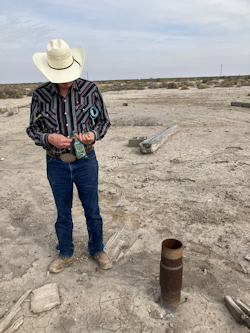 |
| Rancher Schuyler Wight stands next to an orphan well on his property near the Pecos River in the Texas Permian Basin. Photo: Martha Pskowski. |
Orphan wells are the paper trail of how the industry has left innumerable assets for the public to foot the cleanup bill.
Beyond orphan wells, there are also over half a million marginal wells across the country that produce less than 15 barrels of oil a day but can release significant amounts of methane.
These marginal wells generate little profit. This means they are vulnerable to being orphaned in the future because the plugging cost exceeds the income from the well.
The Bipartisan Infrastructure Law created the Federal Orphaned Well Program in 2021 to provide $4.7 billion in funding to plug, remediate and reclaim orphaned oil and gas wells.
While the Trump administration froze these funds earlier this year, they started to flow again later in the spring. In July, the U.S. Department of the Interior announced updated guidelines for states to access the funding, including removing requirements to measure methane emissions. Experts acknowledge that even with significant federal funding, more resources will be needed to get through the backlog.
Some companies have turned to selling carbon credits from orphan well plugging. This is a fruitful area for accountability reporting.
Failed regulations, failing plugs
Policymakers in a few states have introduced legislation to prevent more wells from becoming orphans — often with bipartisan support. They acknowledge that orphan wells are a sign of failed regulation.
Texas has a new law to tighten rules for inactive wells, which are prone to becoming orphan wells. A similar bill also recently became law in Oklahoma. Reporters elsewhere can investigate what their state is doing to close these regulatory gaps.
Undocumented orphan wells are another issue ripe for environmental reporting. Many oil and gas wells drilled decades ago were not entered into state records. Some states are working to identify these wells and add them to their plugging lists.
Meanwhile, well pluggers and advocates are finding that plugs do not last forever.
In Texas, one landowner who
documented how plugged wells
are leaking on her property has
brought a lawsuit against Chevron.
In Texas, one landowner has documented how plugged wells are leaking on her property. She brought a lawsuit against Chevron. Her lawyers refer to these as “zombie wells” that have come back to life after being plugged decades ago.
Helping you drill down
If you’re ready to drill down on the story of orphan and marginal wells, here are some resources to get you started:
- The U.S. Department of the Interior Orphaned Wells program webpage has a wealth of reports, data and maps.
- The United States Geological Survey’s Orphan Wells Project has numerous studies and reports available online. USGS scientists leading the program are good sources for journalists.
- The Environmental Defense Fund has maps of orphan wells and state-level reports full of reporting ideas.
- The Well Done Foundation, a nonprofit based in Montana, plugs orphan wells in numerous states. It is currently plugging wells in the Deep Fork National Wildlife Refuge in Oklahoma.
- Another nonprofit, RMI, has analyzed marginal wells nationwide and their contribution to methane emissions.
- Many states operate their own orphan well plugging programs, often housed within an environmental or natural resources department. Some of the largest are in Ohio, Pennsylvania and Texas.
- Landowners who lease their property for oil and gas drilling often have experience with orphan wells. Ask the organizations representing mineral rights owners how this issue impacts their members.
- Many orphan wells are located on public land. Look into plugging projects in national parks, on Bureau of Land Management land and in national forests.
And finally, don’t forget about the technological innovations that are also driving the discussion today: companies like Biosqueeze that are using biomineralization to plug wells; artificial intelligence tools digging through old maps to identify orphan wells; and scientists using drones to find wells.
[Editor’s Note: Material for this story was drawn from a panel moderated by Pskowski at the Society of Environmental Journalists’ annual conference in Tempe, Arizona, in April 2025, whose sponsors are listed here. For more on this topic, see our Reporter’s Toolbox on orphan well databases, an Issue Backgrounder on earlier funding plans for their cleanup and an Inside Story Q&A on dry oil wells affecting low-income communities in California.]
Martha Pskowski is a Texas reporter at Inside Climate News. She lives in El Paso and covers the oil and gas industry, water issues and extreme heat. She recently contributed an Inside Story Q&A to the SEJournal about her award-winning reporting on regulatory capture by the oil and gas industry in Texas.
* From the weekly news magazine SEJournal Online, Vol. 10, No. 43. Content from each new issue of SEJournal Online is available to the public via the SEJournal Online main page. Subscribe to the e-newsletter here. And see past issues of the SEJournal archived here.
SEJ Publication Types:
Topics on the Beat:
Region:
Visibility: